Voracious Reading – The foundation for successes in quiz and academics

Aadi Arya Karthik was a voracious – fast and deep – reader since the time he started reading by himself. The last few years of his life he took it to a different level. That was what helped him become somebody whose peers described as the three best players in their lifetime. Here is his journal of all the books he read.

All the books* I have read

By Aadi Arya Karthik

(* Not all books. Everything but poetry)

11/7/2023

Agapē Agape is William Gaddis

“Stop Player. Joke No. 4” – a 1951 essay by William Gaddis

11/8/2023

A Reader’s Manifesto – a 2002 book by B. R. Myers

Why Experimental Fiction Threatens to Destroy Publishing, Jonathan Franzen, and Life as we Know It – Ben Marcus

11/15/2023

“The Scent of Apples” (1900) – Ivan Bunin – barely a story, but more a series of childhood experiences, of sensory impressions.

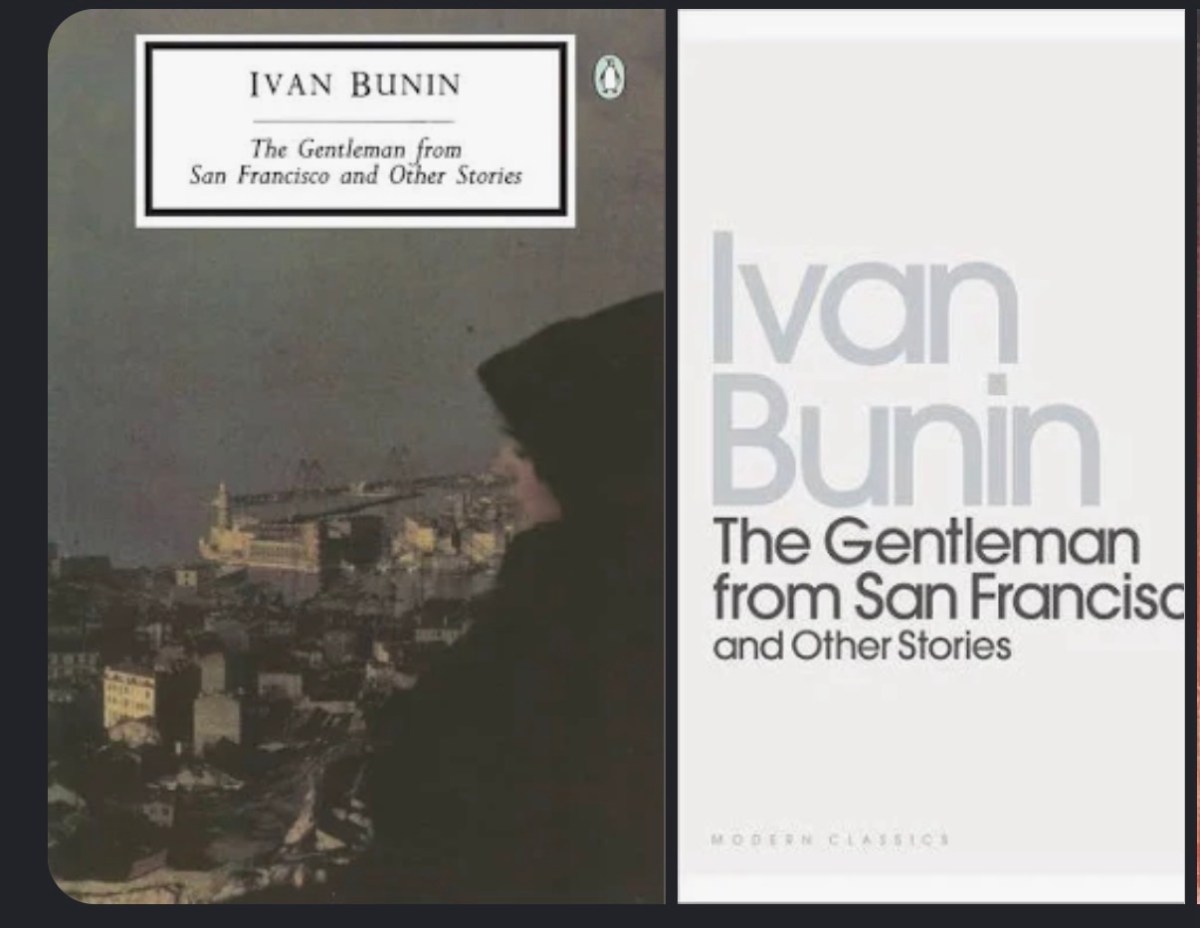
“The Gentleman from San Francisco” – short story by Russian author Ivan Bunin (1915)

12/1/2023

“Beads and Money: Notes toward a Theory of Wealth and Power” – David Graeber (1996)

12/6/2023

The Confession – Anton Chekhov

He Understood! – Anton Chekhov (1883)

Death of a Salesman – Arthur Miller (1949)

12/8/2023

Inferno, I, 32″ – Jorge Luis Borges (1960)

Paradiso, XXXI, 108 – Jorge Luis Borges

Infante’s Inferno (originally La Habana para un infante difunto) – Guillermo Cabrera Infante

12/9/2023

The Lover – Marguerite Duras (1984)

The Hairy Ape – Eugene O’Neill (1922)

The Emperor Jones – Eugene O’Neill (1920)

12/14

Venus in Furs – Leopold von Sacher-Masoch (1870)

The first national Championship- this time high school …

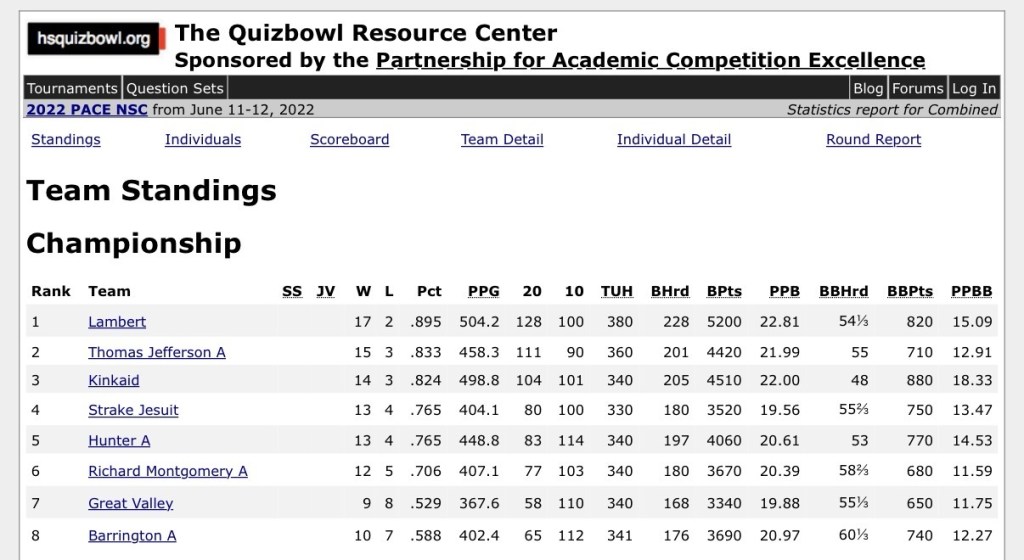
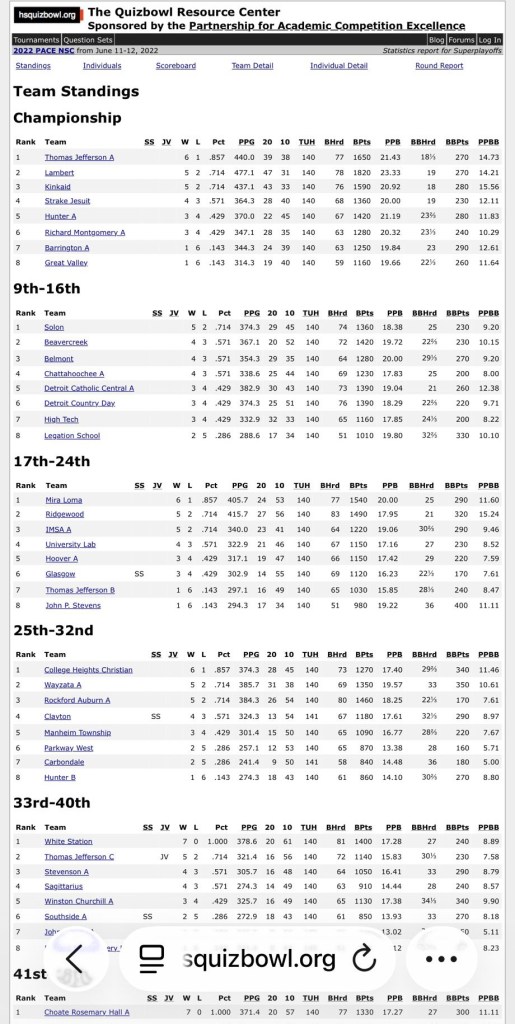
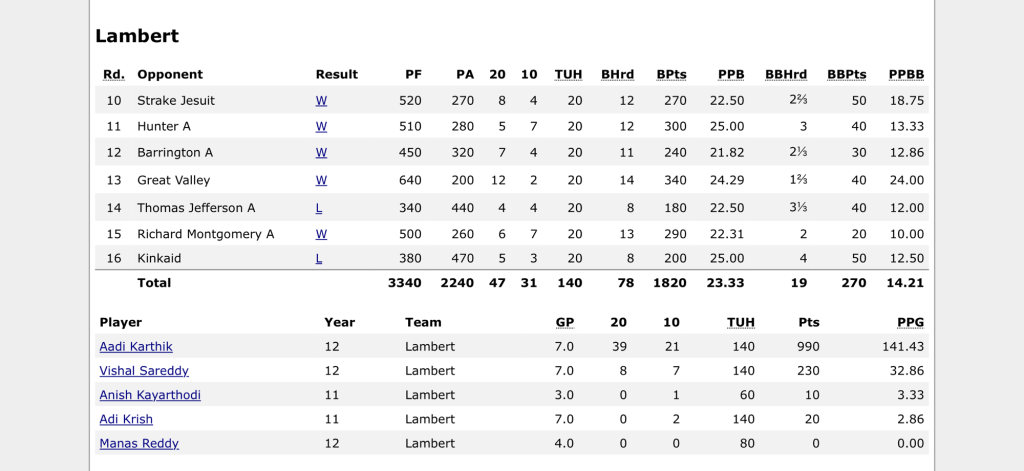
Lambert High School (GA) won the 2022 Partnership for Academic Competition Excellence (PACE) National Scholastic Championship (NSC), defeating runner-up Thomas Jefferson High School for Science and Technology (VA) in Rosemont, Illinois. The tournament took place June 11-12, 2022, with Arya Karthik from Lambert named the top scorer.

Aadi Arya Karthik was part of three quiz national championship winning teams in four years.

The first one, and the one that was the most difficult of those, was representing Lambert High School in May 2022 at Pace NSC.

Lambert High School (GA) won the 2022 Partnership for Academic Competition Excellence (PACE) National Scholastic Championship (NSC), defeating runner-up Thomas Jefferson High School for Science and Technology (VA) in Rosemont, Illinois. The tournament took place June 11-12, 2022, with Arya Karthik from Lambert named the top scorer.

Lambert High School defeated Thomas Jefferson High School twice in a row in a disadvantaged final to take the title. That is the first of two in a row for Aadi Arya in a national championship where their team was disadvantaged meaning their team had to win twice while the other team had to win only once to claim the title. In 2023, Aadi Arya’s Georgia Tech team will do the same against University of Chicago A team.

Final standings after the two rounds of finals

Thomas Jefferson high school is a magnet school drawing the best students from a wide geographic area and hence naturally stacked with talented players. They were not only a perennial power but also were the two time defending champions coming into the tournament. Against that Goliath in the finals, was Lambert High School, a public school drawing students from a fraction of a small county north of the main metro area.

Aadi Arya was devastated after the prior quiz tournament, just the previous month, where Aadi Arya’s performance on the final day was not up to the usual high standards, placing Lambert lower than the team should have expected.

Right after that, Aadi Arya was admitted to the hospital for more than 3 weeks and barely recovered in time for this tournament in Chicago.

To make matters worse, they not only lost to Thomas Jefferson but also lost to another team in the preliminaries and barely made it to the finals.

Standings before the playoffs – Lambert had to defeat Kinkaid and then defeat Thomas Jefferson in a disadvantaged finals to win it all

In the finals, Lambert and Aadi Arya won the first game handily setting up a winner take all final game. In the second game they fell behind so much that it looked like a lost cause. At one point, the only chance Lambert had to win the game was to answer every one of the remaining 6 questions right and had to do answer each of them before the opposing team can buzz in and answer right. The pressure was telling on both teams in a big auditorium filled with parents, viewers, and players from most of the other teams.

The last question (with Lambert trailing by 10 points) showed the respect Aadi Arya had earned from every one in that room. As soon as the first three words of that question was read, everyone realized that it was a question about music and Aadi Arya was going to buzz in and get it right and nobody else was going to be able to answer it faster.

Phenomenal win. First national championship in any sport for Lambert High School.

The whole team stayed up all night playing games and talking before the flight the next morning knowing that the seniors in the team had played their final high school quiz bowl game and came out victorious against the best in the nation.

Individually, he scored nearly 75% of the team’s points but finished second in points per game against another terrific player – Aiden – who played solo (he finished 18th in the team standings).

May You Always Walk In Sunshine – Remembering AAK’s birth month

Aadi Arya Karthik,

May you always walk in sunshine and God’s around you flow, for the happiness you gave us, no one will ever know.

It broke our hearts to lose you, but you did not go alone, a part of us went with you, the day God called you home.

A million times we needed you, a million times we’ve cried.

If love could only have saved you, you never would have died.

The Lord be with you and may you rest in peace.

The second national Championship- this time college …

Aadi Arya Karthik achieved three national quiz championships in four years, including a significant win with the Georgia Tech A team at the 2023 ACF Nationals. They overcame the University of Chicago A team twice in a disadvantaged final. Arya’s strong performance was crucial amidst challenges faced by the team.

Aadi Arya Karthik won three quiz national championships in four years.

The second of that was representing GT (Georgia Institute of Technology) in April 2023.

Georgia Tech A won the 2023 ACF Nationals, cementing a major victory in the quizbowl community. Key members included Hari Parameswaran, Matt Bollinger, Alex Li, and Aadi Arya Karthik, with the team competing in various high-level tournaments throughout the 2023 season.

Georgia Tech A team defeated University of Chicago A team twice in a row in a disadvantaged final to take the title. That made it two in a row for Aadi Arya in a national championship where their team was disadvantaged meaning their team had to win twice while the other team had to win only once to claim the title. In 2022, Aadi Arya’s Lambert team had to do the same against Thomas Jefferson

Due to unanticipated “travel hell”, the prior year’s top scorer for Georgia Tech team was unable to arrive at the tournament until Georgia Tech A had already played five rounds of prelims. Due to Aadi Arya’s strong performance during those 5 games, the team went 6-1 in the prelims, taking a loss to Duke (which ultimately carried over into playoff standings) while Bollinger was absent.

Final quiz bowl tournament …

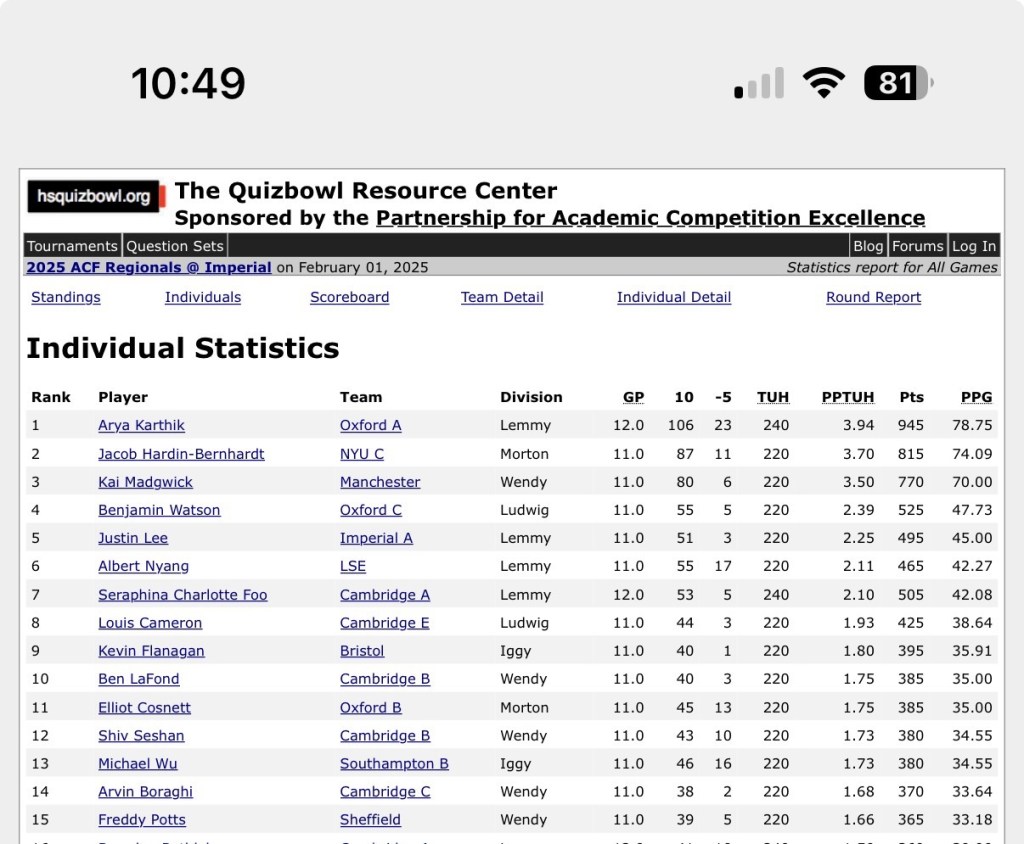
Aadi Arya Karthik led Oxford A to victory at the 2025 ACF Regionals, defeating Cambridge A with a score of 420 to 140. His performance included 106 high-value answers and a points-per-game average of 78.75. Karthik’s quick thinking aided a team member facing travel issues, showcasing his compassion.

Aadi Arya Karthik’s final quiz bowl tournament turned out to be the 2025 ACF Regionals @ Imperial
College on February 01, 2025 helping Oxford A defeat Cambridge A, helping Oxford qualify for ACF nationals in the US. Final score Oxford A 420, Cambridge A 140. Technically, third national championship that he and his different teams of 3 others have been part of, though the last one was UK.

Individually, Aadi Arya Karthik top scored.

Individual Statistics 2025 ACF Regionals at Imperial College

On February 1, 2025, several transit issues affected travel across the UK causing angst for one of the members of Oxford A team. The team was mentioning how fast Aadi Arya played that day to get the tournament finished so the distressed Oxford A player can get on an earlier train and avoid the disruption. The appreciation from those team members for the compassionate actions of Aadi Arya while also making sure Oxford won was gratifying to hear and the behavior we had come to expect.

ACF Regionals (February 1, 2025): Karthik competed for Oxford A at the ACF Regionals hosted by Imperial College London. Oxford A finished 1st out of 20 teams, with Karthik leading the team with 106 “powers” (high-value answers) and a 78.75 PPG (points per game) average.

Touched so many … (2)

As we sit here thinking about you on the first anniversary of you leaving us all, all the appreciation from your quiz bowl friends just touch us so deeply.

https://www.hsquizbowl.org/forums/viewtopic.php?t=28990

2024-2025 Player Appreciation Thread

“I can’t talk about my time in Georgia without also talking about the most passionate, intellectual, kind, driven, and overall amazing person I had the honor of being friends with. Arya Karthik was such an inspiration to me, both in Quiz Bowl and out of it. Every conversation with them was a treat to be a part of. It’s hard, knowing that I won’t get the opportunity to have one more lunch with them. Even now, it still hasn’t fully sunk in. But the memory of them, the impact they left on me and everyone else, that will always be a part of me, etched into my heart. Arya will always be a part of my life, forever and more.”

2023-2024 Player Appreciation Thread

“ … a shout-out to Arya Karthik. It’s been so fun getting to know them better, and I’m very glad they returned to QB because it is insane watching them play. Their knowledge is absolutely ridiculous, their style of play is so unique, and their passions are intense. Every time I meet Arya, I feel like I’m being treated to a lunch date with a brilliant genius in the making. I can’t wait to see how they progress in England, and you can bet that I’ll be reading Ariadne, of Naxos page-to-page once they’re done with it.”

“Among the people in that server, and likely in all of quizbowl, the person I am closest with is by far Arya Karthik. Arya and I began becoming close over the last couple years, and they have inarguably been one of the most important people in my life, in or out of quizbowl, over the past year. As they mentioned, their linear algebra help has been duly noted and will be repaid in due time (never). They’ve been a consistent presence who I’ve been able to turn to about anything, big or small, quizbowl or not, for a good deal of time now, and I really can’t imagine what I’d be like now without having them in my corner and getting the privilege to be in theirs. I’ve now gotten to play ESPN with them (quick shout-out to Iain Carpenter and Jacob Hardin-Bernardt, my other teammates for that tournament who were both a great time), which was a great experience for me as someone who (1) was not that used to very difficult quizbowl and (2) hadn’t had much experience playing with someone who was so above my skill level. Their intelligence is both fascinating and stultifying, and being able to talk to them about any topic is an honor and a privilege. If you have a chance to make their acquaintance, you should take it, and if you don’t, you should get one. I could ramble on about them for many paragraphs but I will refrain from doing so for all of our time.”

“Now: there are two people who I would really, really like to thank, and whose presences have been utterly indispensable to my life as it currently stands (and, presumably, will stand for a long while to come). I cannot be so specific as I’d like but if you are one of these people then you’ll know the depth I’m entailing.

The second of these is Arya Karthik. This is probably impossible to word succinctly, much less on a public forum, so allow me to speak strangely. I want to thank them for:

  • Their love of illegal snails.
  • Being a strong poet. And a strong editor, at that, but presumably not in the same sense.
  • Cocircumpunctuality.
  • The endless discussions, about anything, anything at all, because any discussion with them is worthwhile.
  • The words “svelte” and “ecdysis.”
  • Anything you have ever said on the topic of Lacan, so I don’t have to read Lacan.
  • Finnish soapstone merchants.
  • Their love of non-illegal snails.
  • Everything – from our old readings of Geoffrey Hill and Hart Crane, and our wild, early attempts at writing, to OLP1 and that nightmare, up to those grand worldsweeps of nighttime discourses that will stay emblazoned on my memory for all my life. All of it meant something and all of it is a gift.”

Touched so many …

As we sit here thinking about all the positive impact that you had on this world in your short time here, couldn’t but reflect on one of your friend’s Dad’s sincere appreciation.

https://unraveledandundone.wordpress.com/2025/05/19/the-life-and-death-of-arya-karthik/

The life and death of Arya Karthik

If you would have told me that I would one day find myself in a car with my one and only son, headed to Georgia to pay our last respects to the stranger I saw conquering the National Quiz bowl world on stage 5 years before, I wouldn’t have believed you…but there we were, driving 12 hours one direction to eventually arrive to say farewell one last time. For my son, you were so much more than a friend, you were his other half, a dichotomous relationship that both baffled and amazed me. It was everything I wish more of the world was capable of, but never will be. And while I know he loved you, what you were unaware of, was that his mother and I loved you too…because you loved our son well. You were a gift, someone he had been searching for his entire life, and so had we. It truly did our hearts good to know you were in his life, that he had someone to talk to that truly understood him in ways we never could…and our hearts were broken too, hearing of your sudden passing. I know my son was scared to even ask if he could go to say his last goodbyes, but it was never a question in my mind. I would have moved mountains to make sure he was able to be present. I know that kind of loss…at least, to an extent. We spoke of you for hours off and on, and for so much of it, we just let the passing of time hold a place in our midst. We shared the colors of Kentucky, strangely surreal, the walls of traffic polluting the mountains and the beauty of the yet undeveloped land, something symbolic of our trip to say our farewell. We shook your father’s hand and hugged your mother…and we watched, the memories of your life plastered on the walls, polaroids of accolades and accomplishments, and smiles, a mask forever worn to fool the masses into believing you weren’t feeling so ever alone…but I saw it. It was in every picture and it was the face you showed me the only time we met. Every photo was either you doing something alone or with your team, a smile for a photo, and a loneliness you concealed for a lifetime. My heart broke. For you, your family, for my son, because it was all too easy to see him in those photos. We mourned your loss. We still mourn your loss. We still feel the absence of something beautiful…someone beautiful. As much as I wish we could undue such choices of finality, your life was something of an enigma, even for those that knew you better than most. There will forever be questions about why, probably more so for your mother, but even for Gabe…for me. I’ve walked this path enough times since losing my best friend and even still, I don’t have answers. The brokenness of this world seems a cruelty for such a loving God. My heart hurts all over again, for you, but so much more for my son, because he has to learn what it feels like to live with the absence of something beautiful and it is a sorrow that doesn’t end. There is no filling the void of loss. It is the one thing where my words do little to comfort because grief doesn’t really ever end, it just changes and one either learns to live on or they don’t, but there is no “getting over it,” anymore than one truly ever “gets over” loving someone. It’s a wound that changes. Some days it aches more than others; some days, it feels numb; and some days, it feels like it gets ripped open-a scent, a phrase, a song, a place…life is fucking ruthless at times and it’s the only thing that’s guaranteed: we will all one day suffer the loss of losing another. You were loved. You still are. You ever will be because you loved my son well. Your life had meaning and it still does. My only regret is that I was never able to thank you for the life you lived and the way you loved. Arya Karthik, in life and death, you gave me a gift and a memory I will ever cherish with my son. We are closer because of you. Thank you.

A. W. Forrest

Aadi Arya Karthik NAQT awards

Individual Awards

Arya Karthik has won six individual awards at NAQT national championships:

  • All-Star (4th place) at the 2024 Intercollegiate Championship Tournament
  • Top Undergraduate Player (2nd place) at the 2024 Intercollegiate Championship Tournament
  • Top Undergraduate Player (4th place) at the 2023 Intercollegiate Championship Tournament
  • All-Star (4th place) at the 2022 High School National Championship Tournament
  • All-Star (5th place) at the 2021 High School National Championship Tournament
  • Top Freshman (4th place) at the 2019 High School National Championship Tournament

Source – https://www.naqt.com/stats/player/?contact_id=390382

Quiz Bowl Phase

Reproduced from https://www.qbwiki.com/wiki/Arya_Karthik

Arya Karthik was a player for Oxford, as a visiting student from Georgia Tech, and an alum of Lambert High School in Georgia, noted for their strong generalism and scaling ability.

High School

Karthik led Lambert to a T-19th finish at the 2021 HSNCT and an 8th-place finish at the 2021 NSC, where they led the field in scoring and power count as a junior. 

In 2022, they helped Lambert improve to a T-15th finish at HSNCT before repeating as NSC leading scorer en route to winning Lambert’s first ever national championship at the 2022 NSC. They also were the top scorer on the Georgia NASAT team that placed 2nd at the 2021 NASAT, where they once again led the field in scoring.

College

Arya made an immediate impact on the collegiate circuit at Georgia Tech, propelling the team to a 4th-place finish at the inaugural IQBT Undergraduate Championship and a 5th place finish at 2023 ICT. They were on the winning team at 2023 ACF Nationals, where they won an All-Star scoring award and kept the team on course for the playoffs while unexpected travel delays kept Matt Bollinger from the tournament for most of the prelims. As a visiting student at Oxford, they won and top scored the UK mirror of 2025 ACF Regionals

Writing

Arya was a major contributor to the Southeast-Midwest Housewrite, writing a large number of questions for the set. They also served as a subject editor for 2023 Chicago Open.

Scoring Title

NSC Leading Scorer 2021 and 2022

Etotheipi

“Etotheipi” (Lulu) is a username associated with Arya Karthik, a prominent quiz bowl player known for their, often called “insanely” high-level play. Karthik, an alum of Lambert High and a former student at Georgia Tech, has played for Oxford and is recognized for their unique, intense style.

The Oxford Terms – Finitude and Infinitude

Full text of one of Aadi Arya Karthik submissions for a class at Oxford.


Finitude and Infinitude
There is an obvious and immediate inconsistency in treating the finite and the infinite as
two poles standing against each other, two ends of a continuum: to do so is to strip the infinite of
its infinitude. Every something is definitionally finite, bounded in both time and space: comes to
be at its birth, and comes to be at its edges. To set the finite against the infinite as something
against something else is thereby to bound the infinite, to make it “just another finitude,” so to
speak—to render it an untruth, a “bad infinity.” And “bad infinity” is that infinity which is
proximally understood: the infinity of the ad infinitum, the interminable. For to declare that a
given process does not terminate is to note its repeating of the same (finite) algorithmic steps in a
manner that will not lead to termination, and so to represent infinity as a stack of finite blocks
whose apex is simply always further than the eye can see. The word interminable indicates a
negation in the proximal sense, but not a Hegelian negation, there being nothing affirmative
about it; not a critique, interminability prompting or resolving no crisis in terminability. This
discrete infinity presents itself as and in a swindle of sorts: what is discretely infinite is never
something that one can actually come to know in any sense; one is simply told to take on faith
that what one sees will go on forever. Any concept of discrete infinity, then, covertly imports
with it a concept (a vulgar concept, that is, not a Grenzbegriff) of the thing-in-itself, or at least a
concept with the same intolerable flaw as the concept of the thing-in-itself: its artificial positing
of some fraction of nature which we cannot and do not know.
A more sustainable infinitude is needed; and Hegel’s solution is what one might think of
as continuous infinitude: that is, a rendering of infinitude immanent and therefore a making of it
philosophically proper in some sense—not a swindle. This new concept is quite easily
exemplified mathematically (whence my motivation for using the descriptors discrete and
continuous): the infinity of the set of all natural numbers is a “bad” infinity; the infinity of the set
of all real numbers between zero and one is proper, being the infinity that constitutes an interval
“finite enough” to present itself to us at once. (It is notable, of course, that even mathematically
these are two different infinities, the latter being “bigger” than the former.) Hegel’s own example
is perhaps more philosophically profound: true infinity is evidenced in the “relation [of an entity]
to itself in its transition and in the other”;1 true infinity is the finite entity’s “attain[ing] its being-
in-itself,” “rejoin[ing] itself,” in its termination, its death.2 After all, what characterizes the finite
entity in its finitude is its coming-to-an-end (equivalently, its coming-to-be); a finite entity is not
finite unless and until it is resolved that it will have died. But a purely finite entity also cannot
undergo death in any real sense, since at the moment of death it is no longer itself but something
else: that is, it is correct for me to insist that I will never die, in the sense that at any point there is
an I to speak of it has not yet died; death is always yet to come. Hegel gives the spatial
equivalent of this argument: “something can be known, even felt to be a barrier, a lack only
insofar as one has at the same time gone beyond it”;3 the finite entity must at once remain within
its spatial limits and extend past them. The declared finitude of the entity conceals an infinitude
immanent to the entity, an infinitude which is the very act of reaching into the other, whether this
reaching is conceived of as the entity’s reaching past its limits—its being related to that which is
other than it—or the unit interval’s being in bijection with the set of all reals, this bijection
perhaps metaphorically constituting its own relating to the other, its own reaching-past.4 True
infinitude is not the infinitude to which the finite is opposed, but the infinitude which all
finitudes betray upon inspection.

However, true infinitude is not the finitude which all “bad infinitudes” betray upon
inspection; true infinitude is intended as a replacement for “bad infinitude,” not as a sublation of
it.5 Elsewhere, Hegel in fact assigns the axiom which identifies the “finitized infinite” with the
“infinitized finite” to the fallen understanding, names this identification “scandalous.”6 At very
least it is made clear that there is no structural, topological, methodological equivalence between
the dialectic consisting of being, nothing, and becoming and that consisting of the bad-infinite,
finite, and true-infinite: the revealings, vanishings which take place in the former seem not at all
paralleled by those taking place in the latter. Being vanishes into nothing and nothing into being
the moment they are articulated (whether in the intellect or in the world): the concepts are
volatile. Likewise, it is not difficult to conceive of becoming as “spontaneously generated” by
this vanishing; that is, the vanishing of being into nothing, and of nothing into being, is not to be
explained by becoming: becoming is simply and plainly exhibited there. In other words, the
being, nothing, becoming triad is exemplary in that it presents a phenomenon that may be clearly
phenomenologically described as taking place in the same way “in thought” and “in reality”: its
exposition parallels its conceptual form, which in turn parallels the affinities of the concepts
themselves, their action independent of the observer. This exemplarity seems not to be present in
the second triad, as we will see below.
It is worth first discussing exactly what the first two moments of this triad—whose third
member must be true infinitude—are to be. The triad bad-infinite, finite, true-infinite seems most
consonant with the facts of Hegel’s exposition, as well as his broader aims, given that he argues
from the inadequacy of the bad-infinite to the adequacy of the true-infinite, and that Hegelian
dialectic is to be a method of arguing from inadequate concepts to adequate ones. But Hegel is
careful to specify that the bad-infinite is not sublated in the true-infinite, is nothing more than a
failed attempt at sublating the finite;7 to take as axiomatic the self-consistency, the intelligence of
a great thinker like Hegel—the notion, more precisely, that he knew what he was doing, that any
glaring or critical error one finds is more likely an error on the part of the reader—this being
really the only axiom I am comfortable regularly taking—is to discount the idea that Hegel is
arriving at the truly infinite via this particular dialectic. Hegel also hints at a possible alternative
dialectic triad, that of something, Other, and true-infinite as the reaching of the (finite) something
into this Other. However, this dialectic movement presents its own difficulties. For one, both
being and nothingness are perfectly fine starting-points for their respective dialectic motion,
given that the vanishing of one into the other is the vanishing of the other into the one, thus
suggesting a symmetry between the first two terms of the dialectic. But one cannot posit an
Other before one posits a something; that is, a positing of a (finite) something—for Hegel, at
least, it must be said; I do not think the following obtains at all—immediately mandates and
indeed brings about the positing of an Other into which this something may reach, but a positing
of an Other cannot even take place without the prior positing of a something for the Other to
stake its Otherness upon. In addition, it is not entirely clear why the positing of a particular
something and its Other ought to bring about true infinity as concept and not a true-infinity, nor
is it clear that the above dialectic works when something is replaced by something-ness and
Other is replaced by Otherness. (One objection: Hegel does, I think, hint at this approach in
identifying determinate being, i.e. existence, with being-so, being something—reality8—but the
difficulty lies in articulating Otherness as a universal rather than a particular, which Hegel does
not even seem to attempt.) Finally, and most vitally, Hegel at no point indicates that he is using
this dialectic, making this particular maneuver; given that the rational structure of Hegel’s
exposition is actually to be the rational structure of the Umwelt, I think that claims of the type
Hegel meant to say [something] but did not do so do not hold water: the system is the system as
it is presented.
In either case, basic failures to parallel the architecture of the being, nothing, becoming
dialectic are exhibited; I think that it is only fair to mark these failures as intended. We are then
left with the problem: what grounds does Hegel have to use two different “dialectical”
procedures in the course of the exposition of his system? One might attempt to take dialectic to
indicate critique of critique—as I suggested it might be in my last essay—rather than the more
peculiar threefold process which is typically said to be Hegel’s; it does not seem, however, that
the derivation of true infinity might even be said to have the architecture of a critique of critique.
I believe this problem to be identical to, or at least answered by the same realization as, another
pressing one I have come to in my reading of Hegel: how does Hegel know where to stop his
derivation? The being, nothing, becoming dialectic is in itself a closed loop, a perfectly self-
similar system seemingly adhering to all of Hegel’s aesthetic commitments (I do not mean
aesthetic as a pejorative; all good commitments are aesthetic commitments); the only reason to
move beyond it is because one brings into the derivation some notion of what philosophy ought
to be and do—a notion which is a facticity, a product of one’s thrownness, perhaps—and finds
this dialectic insufficient. It is accepted enough that what is remarkable in a sentence is not the
words that constitute it but their arrangement and context both inside and outside the sentence,
signs being interchangeable; it is not too different to assert that what is remarkable in a thought is
the arrangement of “thought-content” within it, rather than the thought-content itself. A
meaningful portion of what is remarkable in the derivation of a system, then, is where the
derivation ends, where the system declares itself entirely systematic—which seems in Hegel to
evince an infiltration of the empirical into the system itself. I am sure Hegel will prove to be able
to evade this line of argument; I am simply at the moment not quite sure how.
—-

1 Hegel, The Encyclopedia Logic, s. 95.
2 Hegel, The Science of Logic, 21.123.
3 Hegel, The Encyclopedia Logic, s. 60; quoted in Moore, The Evolution of Modern Metaphysics, 165.
4 I am not particularly happy with this metaphor, but it’s orthogonal enough to the main direction of argument and
does its job well enough that I’ll leave it in for now.
5 See Hegel, The Encyclopedia Logic, s. 94.
6 Hegel, The Science of Logic, 21:132.
7 Hegel, The Encyclopedia Logic, s. 94.
8 See Hegel, The Science of Logic, 21:102.

The Oxford Terms – Hegel and Idealism

Full text of one of Aadi Arya Karthik submissions for a class at Oxford.

Hegel’s Idealism With Respect To That of Kant

I offer two characterizations of Hegel’s idealism, both as situated in metaphysics

generally and as situated relative to Kant’s critical philosophy: a more orthodox account of its

emergence out of a critique of Kant’s everywhere-mediation, and a slightly odder account

involving Roman Jakobson’s metonym-metaphor dyad. The positions that (a) Kant was a thinker

whose radicalism was missed by Hegel and (b) Kant was radicalized by Hegel are in the

orthodox account suggested to be mutually exclusive; I would like to suggest that both are in fact

true, that Hegel comes to his properly radical critique of Kant by eliding what is more subtly

radical in Kant—what in Kant deviates from what one ought to expect of an idealism.

[i]

Let us take the word metaphysics in the Kantian sense, as denoting the entire system or

scaffolding of a priori truths which the I (I avoid subject because of its overtones involving

subjection, hierarchy, which I believe are not present in the German, and self because such a

notion only comes about when the I has already been taken as an object) takes with her into her

experiencing.1 Familiarly, a metaphysics is called idealist if it asserts the mind-dependence of

reality, though it has been pointed out that really the word should designate any theory that is

realist about some entities that might fairly be described as “mental”—whether this denotes the

inside-the-mind-ness of a belief or idea or the impenetrability to anything but mind of, say, a

Platonic Idea.2 I would however like to here work with a stricter conception of the word, as

denoting a metaphysics which posits a total structural congruency between the I and her

environment (i.e. Umwelt, which is to be distinguished from the world). What exactly the nature

of this structural congruency ought to be is up for debate, but might for example be posited to be

a grammatical congruency: any true statement analyzing the I may be converted into a true

statement analyzing the environment simply by substituting some terms for their coordinates in

the other regime. (Robert Brandom, for example, seems amenable to a procedure much like this

one, with coordinateness further explained as reciprocal sense dependence.3)

We may further elaborate this definition, along Hegelian lines,4 into a distinction between

subjective and objective idealism: the former writes structural congruency as unidirectional,

mechanistic, the I constructing or bricolaging her environment into the only structure she

intimately knows, i.e. her own; while the latter writes structural congruency as an imperative

visited upon both I and environment “from beyond,” though of course this beyond may denote an

entity either transcendent or immanent. In both cases, three parties are involved: the I, which is

never part of its environment insofar as it is traditionally agent, but also insofar as it has the

faculty to encounter, to look upon this environment as an environment, and so “from outside” in

some sense; the environment as a manifold which is always in some measure fallen, which has a

component of mere appearance rather than actuality, contingency and coincidence rather than

necessity (fallen also in the sense that there exists no imperative to render the system back into

actuality—that actuality will only exist inside it and not of it, through it);5 and some entity which

establishes a relation between the I and her environment, whether this relation is one of

construction, as for the subjective idealists, or one of subjection to some order, as for the

objective idealists. A characterization of this third entity as nous would be conceding the point to

the objective idealists, and a characterization as apprehension would be conceding to the

subjective idealists; I prefer the term language, which, though certainly rather suggestive, allows

for the conception of the entity as both something that may be wielded by the speaker and

something that imposes its own exigencies upon speech, lays out a finite list of permitted

motions within it. Hegel does in fact gesture toward language so traversing, so defining a

perpendicularity through I and environment alike: for him, what each sentence appropriates to

itself are precisely universals, which are the waypoints of thought.6 Language, that is, traces

thought.

It is important to make clear that in Kantian subjective idealism the I’s construction of the

environment is not free in any substantive sense: she is laborer rather than artisan; she is working

by a plan which has already been provided to her. After all, she is modelling the world upon

herself, and she did not model herself. This patently fails to betray any meaningful subjectivism

in the Kantian schema. What Hegel finds “subjective” in Kant really reduces to Kant’s idea that

language has two clearly separate functions: aesthesis and analysis; narration and thought; prose

and poetry. First I come upon a description of the world—an intuition—then I think with this

description, take the sensory data that is given to me by it and come to universals or universal

judgments, “do literary criticism.” For the first step of this two-step process to be valid,

language, contra Hegel, must be suitable for the recounting of representations, particulars, and

not solely universals; it is this first step which ensures that any operation by which one is-in-the-

world, which in our current scheme is a linguistic operation, would by the nature of language be

mediated.

For Hegel, too, the study of thought in itself, and so the study of language, will result in

the production of a complete account of the workings of all three components of the world (I,

environment, language). Both thinkers agree on the necessity of some sort of thinking into

thought or arriving at language: for Kant, this is analysis; for Hegel, thinking over. But for Hegel

a thinking into language in its accessibility to us is already a thinking into the environment

insofar as the latter is actuality and not appearance, insofar as the latter partakes in the same

Absolute as I do, given that the Absolute is self-similar.7 After all, in Hegel’s words, “was

vernünftig ist, das ist wirklich, und was wirklich ist, das ist vernünftig”:8 here, vernünftig does

not comfortably correspond to its usual translation rational, given that the latter indicates taking

what one might call a statistical perspective, a coming to structure thanks to reasons, to

arguments—mediatedly—while the former indicates a more conceptually primitive, pure, total

grasping, taking up, perhaps of a literary or mathematical nature. There is a univocity between

language as it is taken up, worked over, and happenings as they play out.

Thus, while language in Kant is an inherently private thing which I use to make my world

livable and at least have an understanding with myself, language in Hegel is a reliably

communicatory entity, a coin valid wherever one might go. After all, Hegel does not tolerate the

Spaltung between the problematic (that which demands treatment by thought) and assertoric (that

which permits treatment by thought)—the Spaltung, the Grenze named the noumenon, which is

defining of the topology of Kantian metaphysics;9 by the grace of the Absolute, by its ever-

willingness to cooperate with us,10 we are free of epistemological limitation: our conceptual

space is unbounded, not finite. I would argue this to be equivalent to the (seemingly

indefensible) claim that what may be explained in poetry will always also be explicable in prose,

since poetry is language’s mechanism for coping with a terrain it can grasp and wield but not fill

in, populate; explicate but not explain: a pure antinomy, for example, like the Trinity. Epistemic

conditions,11 on the other hand, are promulgated during and as a consequence of aesthesis—the

one practically private (because not dealing with universals) mode of language—for the

constraining by form of formless manifoldness is a placing of constraints upon the forms of

knowing more broadly. Then, Hegel’s argument against the form-content dyad—against that

formless content which is to make up the environment, and which is then aesthesized, given form

—against manifoldness at large—functions by promulgating a labeling of aesthesis a fictional

process.12

Under this interpretative regime, the Hegelian advancement upon Kant is suggested to be

precisely a rejection of the admittedly attractive thesis of epistemic conditioning in exchange for

the thesis of the inherent structuredness of nature and the immediacy of our access to such, also

attractive in its jettisoning the manifoldness concept, its evading thereby the standard realist

criticism of constructivist metaphysics: of what do we construct our worlds? what is this entity

called manifoldness, this isolated and unparalleled residue betraying the failure of Kant’s system

to be entirely systematic? (Goodman, I think, had the right idea in characterizing this

manifoldness out of which we hew our own world-versions as simply a clutter of already-made

alien world-versions,13 a solution obviously in no way anticipated by Kant.) In other words,

Hegel eliminates a “good residue”—the noumenon—in his eliminating from metaphysics of

residuality entirely, which for him is both good in itself and does away with a particularly sticky

“bad residue”—manifoldness.

Of course, characterization of the noumenon and manifoldness as residua is already

conceding the point to Hegel; an account that is fair to Kant will point to the residuality of the

concepts obscuring some vital function of theirs, one that Hegel elides. I briefly and broadly

sketch an attempt at this in the sequel.

[ii]

Hegel’s attack on Kant’s maintaining of the form-content dyad is, I claim, really an attack

on Kant’s maintaining of the far more immediately defensible I-environment dyad. After all,

what we call objects attain their objecthood, their over-against-ness, in their standing in some

sense between I and environment; and this betweenness is in no case symmetric. Consider, for

example, the body: I do not think it possible to draw a dividing-line between the body and the I,

though patently the body is not felt to be exactly the I; but clearly one can mark where the body

terminates in skin and what is environmental begins. An encountered, foreign object, on the

other hand, presents as clearly distinguishable from me, but cannot be so distinguished from the

environment, being enworlded. We might call the object an interface between the I and the

environment; then it is clearly an important philosophical question to characterize the

interfaciality of the interface.

Obviously, the interface can only exist if there exists a heterogeneity between whose

poles it might interface; in Hegel, then, there are no interfaces: no ob-jects. Kant, on the other

hand, implicitly and cleverly characterizes14 the interface as that which broadcasts closure to one

pole and openness to another: the body, for example, is closed to the environment and open to

the I with which it is correlated. A more deflationary and reciprocal restatement: the interface is

simultaneously one pole’s openness to the other and the other’s closure against, rebuff of the one;

the body is my openness to the environment taken together with its closedness against me, and

the foreign object is the environment’s openness to me (perhaps in the sense later explicated by

Heidegger) taken together with my closedness against it. It may, I think, be demonstrated that

manifoldness in this conception takes its station as articulation of the openness between the

foreign object and the environment, and that the noumenon is some idea of this environment; it

may more radically be argued that the closednesses in this model, which I call skins, are

structurally congruent, homeomorphic to the conceptual skin which is the Spaltung between

problematicity and assertoricity, the noumenon considered as limit to pretension.15 That is to say,

what to Hegel are mere residua in the Kantian system are really Kant’s way of accounting for the

residua—Hegel’s appearances—that do seem to populate our world.

Of course, the openness-closedness (content-form) dyad only emerges if there is already

an I-environment dyad for these opennesses and closednesses to exist along. Perhaps this is the

most profound sense in which Kant’s metaphysics is a “metaphysic of grief and longing”:16 Kant

conceptually begins at a substantial alienation of the I from her environment which Hegel (who,

at least in Brandom’s interpretation, holds the current alienation of the I to be purely contingent17)

is not willing to concede.

Roman Jakobson has observed that work in any discipline whose medium is the word

(and perhaps in certain other disciplines: art, film…) may be classified as either primarily

metonymic, grounded in relations of contiguity, explication between words and syntagms

(Jakobson gives the example of a hut being associated with the phrase burnt out), or metaphoric,

grounded in relations of synonymy between words and syntagms (Jakobson gives the example of

a hut being associated with the phrase is a poor little house).18 It is clear from the above analysis

that Hegelian absolute idealism is entirely metaphoric; as I have suggested, I believe that it is in

this capacity that Hegelian thought is an idealism in the first place. It might seem that the

metonymic pole is occupied by the most truculent physicalisms, those which seamlessly

integrate man as part of a mechanistically functioning natural whole; however, in this very

integration the part-ness of man is lost: in a real metonym, there always exists a skin

circumscribing the part and defending it against—a process distinct from the Hegelian dividing it

from—the whole. The skin, that is, appears precisely in a metonymic theory; and, as I have

implied, critical idealism might be said to be that out of which emerged the original and

exemplary skin. This suggests, in my view, that Hegel is an idealist exactly insofar as he is against Kant.

——

1 This is, at least, the conception Kant lays out in the Groundwork (4:388); Beiser reads a different definition (54).

2 See Dunham, Grant, and Watson, Idealism: The History of a Philosophy, 6-8.

3 See Brandom, Tales of the Mighty Dead, 194-199.

4 See The Encyclopedia Logic, 90.

5 The Encyclopedia Logic, 33-4.

6 The Encyclopedia Logic, 52-3.

7 See The Encyclopedia Logic, 43.

8 The Encyclopedia Logic, 33.

9 Kant, Critique of Pure Reason, A255/B310-11.

10 Phenomenology of Spirit, 47.

11 The term is Henry Allison’s.

12 This broadly follows Sally Sedgwick’s apprehension of the Hegelian critique of Kant.

13 Goodman, Ways of Worldmaking, 6.

14 The argument I have for this is very long and oblique and so I will not present it here. It’s possible that there’s a more directly exegetical one I’m not aware of.

15 A phrase Kant actually does use for the notion (which he claims is not even a concept but something more

exotic: a boundary-concept), See Kant, Critique of Pure Reason, A255/B310.

16 Sedgwick, Hegel’s Critique of Kant, 85.

17 See e.g. Brandom, A Spirit of Trust, 472.

18 Jakobson, “Two Aspects of Language and Two Types of Aphasic Disturbances,” in Questions of Literary Theory.


The Oxford Terms – On the Lord-Bondsman Model

Full text of one of Aadi Arya Karthik submissions for a class at Oxford.

On the Lord-Bondsman Model

What is perhaps most immediately remarkable about Hegel’s lord-bondsman toy model is

the explicit presence of a third party fixing the interaction: Hegel names it a thing,1 and it is

presumably to be understood as the physical object with which or in whose context the

bondsman labors, which he “forms and shapes,”2 exerts his will upon. I say fixing the

interaction: I do think it precisely to be the presence of such a “good object” upon which the

proper functioning of the interaction hinges. For given the object Hegel is able to rather lucidly

—too lucidly, I would say—describe the lord and bondsman into their respective positions: the

lord as he who for lack of an “independent opposition”—a co-resident of the way-things-are free

to engage him in a combat, a “life-and-death struggle”3 (it is indicative that Hegel here resorts to

a martial metaphor, as is standard for those wishing to smuggle a certain measure of received

idea into their thought) by which the former and latter might come to the truth of their being-for-

themselves—is unable to come to such a being-for-himself; the bondsman as he who has come,

thanks to the lord’s tyranny, to the fear, the consciousness of himself as given over to another,

which is the proper fruit of the combat which the lord evades, and who simultaneously is given

the chance to come to a consciousness of himself as agent rather than mere fact by means of his

work, his lordship of sorts over the object: to whom it is therefore only left to sublate the two

consciousnesses into a true being-for-himself. The lord is certain as to his fulfilment of himself

as subject—he can give any number of correct statements about his position—but he cannot

know this fulfilment to be true, to have meaning, worth, not to be simply delusional—for

legitimacy, which is one’s being-of-worth, must, as a title, be conferred upon one by the other,

not simply taken for oneself; and there is no one in the model who could perform this conferral

who is not already tainted, as is the bondsman, by the fact that he will do anything he is ordered

to do, that his consent is bought and not earned.

But meanwhile it is due to the presence of the object that certain questions are able to be

raised about Hegel’s model: questions that seem to indicate that what is taking place within it

ought to be read rather more carefully. Most immediately: it is not exactly clear what the object

is to be in the case in which the bondsman is a real proletarian: a Marxian would point to the

conspicuous “missed connection” between the assembly-line worker and that in the production of

which they take part, but there is also the cannon-fodder infantryman, the house-servant…

Anyhow Hegel’s portrait of the bondsman in no way accounts for the disillusionment and

directionless anger of a Wozzeck or Franz Biberkopf, or the strange, half-cowering febrility of a

Walser protagonist; clearly those whom Hegel has in mind are artisans at worst. And then there

is the entirely otherwise danger, to which Fanon is attuned, that the artisanal bondsman refuses to

listen to Hegel and “turn away from the master and turn toward the object,” instead “turn[ing]

toward the master and abandon[ing] the object”; I imagine such a bondsman might be found

among the less flattering of the portraits of serfs with which the Russians would stock us:

Chekhov’s or Leskov’s bitterer stories (“The House with the Mansard,” The Lady Macbeth of

Mtsensk), or even those of Gogol, are perhaps most indicative. The issue in this case is that to

work upon an object is not in particularly many cases to exert any sort of mastery over that

object; more often, one is simply worn out by the object’s recalcitrance, and so, or for economic

reasons, is forced to cede a certain amount of the potential mastery to elves (as the cobbler in the

fairy-tale) or tools, technological instruments (as all of us—I am writing this essay not by hand

but on a laptop, after all—in real life). We therefore must accept that the scheme into which the

bondsman is placed is not nearly as universal as Hegel, but more especially his commentators,4

seems to want it to be: his giving of them an object out of which they are to draw some sort of

solace is not the easiest maneuver to imagine—I, for one, cannot really describe what this would

look like.

More problematic is the situation of the lord; while a bondsman “noble” or “saintly”

enough to follow the Hegelian sequence is at least tenable as an ideal of sorts, we are asked to

grant a certain fundamental incompetence on the lord’s part, which, while empirically believable,

cannot really be a priori granted. Most simply, I cannot imagine a man like de Rochefoucauld,

de Maistre, or Lavoisier, despite his obvious lordship, conceding that he does not directly

perform any labor: intellectual labor, the sort that results in a treatise or literary work, is always

direct, and can reasonably be asserted to be more purely labor than that which the tailor or

clockmaker engages in. (Incidentally, Marx manages to critique Hegel in another context—near

that of my critique of the bondsman-concept—on precisely the opposite point: “The only labor

that Hegel knows and recognizes is abstract, mental labor.”5 Hegel has no room in his scheme for

the menial laborer, then, but neither does he have room for the real practitioner of art [and not

just of belles-lettres.]) In what way can the bondsman lay claim to any sort of mastery over the

object when said mastery would be of a vulgar, far-too-literal sort? And then there is the

tendency among authors to see their works not as their own but as very much given to them by

the muses, to see themselves qua authors as servants of some vaguely divine entity: we seem,

then, to have made bondsmen out of the lords, except with their object, language, above them in

this makeshift hierarchy, and the proper serfs irredeemably below. (It should be added that there

is the even more radical maneuver of simply ceding life itself to one’s bondsmen, which the

protagonists of Villiers’ Axël explicitly do. What the precise consequences of this are I am still

nowhere near sure, two years after reading the play.)

It should be reiterated that I do not intend these as criticisms of the lord-bondsman model,

not exactly: that the bondsmen within it are all too saintly and the lords quite stupid does not

count against it in its function as a toy-model, an exemplar, as a scheme with no necessary

correlate in reality. So long as Hegel is not thought to be positing a universal law of recognition,

only explaining the process, we have no ammunition against him. One might even examine the

bluntest criticism that can be made of the model: that it is essentially manufacturing a place for a

third entity, the object, within a scheme which seems only to permit the presence within it of self

and other. This criticism must explicitly be made from the perspective of the lord or the

bondsman—we will opt for the latter—since for Hegel such a twofoldness will only polarize a to

some extent untutored view. How, we might ask, does the bondsman explicitly maintain two

completely opposite relationships with the other: fear of and service to what is picked out of the

other as the lord, and “formative activity”6 toward what is picked out of the other as the object?

For the picking of these entities out of the other seems to rely on some process of

(mis)recognition already having occurred; but to (mis)recognize, reify the entities requires one to

have developed attitudes toward “each of them,” never mind that no each exists at this point.

That is: it is easy to argue from a perspective like mine that Hegel fails in being rigorous where

he fails in being solipsistic; he takes for granted the plurality of a world, the precise nature of the

singularity of which is really all that his metaphysics has given thus far. (And of course Hegel

cannot respond, as would a less responsible thinker, that the world is plural in this sense because

we perceive it as plural.) But to make this argument would be, I think, to miss what makes

Hegel’s systematizing so powerful: namely, he proves knowing what end toward which he is

proving (this being the present way-of-things), and the steps he would need to take to get there

(this being the historical sequence). The gap in the self-other twofoldness which Hegel exploits,

into which he inserts the intensely polyvalent and polymorphous object, is there because it must

be there, because it is there: perhaps Hegel has skipped a few steps in justifying its presence, but

that is only the slip-up of the human chronicling, biographying the Absolute; the Absolute itself

is unassailable, and that—the way-things-are itself—is what one must go up against to go up against the substance of Hegel. (Lacan does this: he is perfectly comfortable situating himself asliterally “against Hegel,”7 and indeed the perverting of Hegel which is the mirror stage might be read as an attempt on the life of the Absolute, an attempt to render [i/I]maginary in one fell

swoop the entirety of the way-things-socially-are.) My previous reservations as to how Hegel knew when his dialecticizing was to stop are invalid by this same line of reasoning: he was to stop once he had the architectonic of the world written down, nothing more or less than that.

That is: Hegel’s refusal to invoke any sort of core or scaffold of brute fact, givenness in his

systematizing was not a methodological precept but a heuristic he maintained so as to be able to

perform such a commitment of world to paper; all of his supposed “presuppositions” ought, I

think, to be read in this light.

After this we are still left with the question of how the model is to be more literally,

faithfully read. I think I have found a lead in Klossowski, but I have not been able to work out a

schema in time for it to be included in this essay. Perhaps I will be able to explain it somewhat

by the tutorial tomorrow, if you would like.

—-

1 Hegel, The Phenomenology of Spirit, s190ff.

2 Ibid., s195.

3 Ibid., s187.

4 Vide e.g. John O’Neill, Hegel’s Dialectic of Desire and Recognition, 7, which seems to posit the lord-bondsman dialectic as component of every coming-to-(self)-recognition.

5 Ibid., 39.

6 Hegel, The Phenomenology of Spirit, s196.

7 Lacan, The Four Fundamental Concepts of Psychoanalysis, trans. Alan Sheridan, 215.

The Oxford Terms – What Is Dialectic For Hegel

Full text of one of Aadi Arya Karthik submissions for a class at Oxford.

What, For Hegel, Is Dialectic?

It seems to me that, in Hegel, for a philosophical construct to be true, it must be self-

similar: for the presence of a substructure within the whole but not structurally congruent to it is

exactly an opposition between part and whole, a crisis which until resolved discredits the entire

apparatus. As such, an account of the dialectic is an account of negation in all its generality. In

the sequel, I will argue that this negation can be understood as critique as the Enlightenment

thinkers practice it, but, pace Jaeggi, is not reflected in psychoanalytic procedure. I will conclude

with a brief point on the difficulty of chaining together negations, as it were, in the manner

which Hegel understands as dialectical.

i.

Critique is crisis.1 That is, critique does not merely emerge in response to an objective

crisis, as proposing a way out of it; in fact, the critique has no intention toward resolution of a

crisis in any way; instead, critique manufactures crisis, forces it, by seizing onto and exploiting a

point of difficulty within or entry into a system. No crisis could come to fruition without the

existence of such a point of difficulty, a glaring one, in the way-things-are, but the presence of

such a point does not by itself a crisis make, not until a criticism targeted at that point comes to

be. (Of course, the argument may be made that the presence of such a point in the way-things-are

invites critique, and as such that in some sense the way-things-are is morally responsible, in its

imperfection, for the crisis engendered—but this does not indicate any sort of causal

responsibility on the part of way-things-are for the crisis. If one refuses a vaccine, it is not

implausible to accuse one of being morally implicated in one’s subsequent illness, but it is

certainly untrue that one caused one’s illness by that act.)

Enlightenment critique was the forcing of such a crisis in and upon the absolutist political

structure of the time: after all, there can be no crisis without a dualism between whose poles the

conflict is to play out, a dualism which was freshly articulated by Enlightenment thinkers in their

separation of a sphere of political activity from a sphere of morality. The parallel hierarchies of

government and of the “republic of letters” were not in the image of, for example, the parallel

hierarchies of the Chalcedonian and anti-Chalcedonian churches in the sixth century: for the

latter, despite their doctrinal conflicts, did not meaningfully disagree on what legitimacy

consisted in: the Chalcedonian and anti-Chalcedonian worked from the same corpus of scriptures

and texts of the Church Fathers, and both understood legitimacy as an orthodoxy with respect to

this corpus. On the other hand, the anti-absolutist thinkers of the Enlightenment, understanding

that, in the absolutist, aristocratic conception, their bourgeois class identity precluded them from

participation in political decision-making—and believing this exclusion, this comparative

illegitimacy, to be unjust—put forth and argued for the universality of an entirely different

standard of legitimacy: one asserted to be generically moral, but really one advancing a quite

specific classical liberal morality heretofore foreign. The monarch was no longer unifiedly a

monarch: he was superposition of human and sovereign, not born above but elevated, subject at

once to the laws of fellow-feeling and those of impartial justice.

In particular, it is only with Schiller, Lessing, Goethe, and their contemporaries that art

becomes critique. This is not to say that art had not been used to what might be familiarly called

critical ends before the eighteenth century; Plato was famously quite aware of the insurrectionary

(to him, distortionary) potential of literature,2 and the Iconoclasms were as much aesthetic

controversies as theological ones. But, until the Enlightenment, there was no ideology of art:

insofar as controversies involving art were political, they were already-existent political

controversies in which artists either took sides or en masse joined with one party, and never

involved any conception of the essence of art constituting its own distinct party. Schiller, on the

other hand, treated art not merely as a force of order but also as a force imposing and eventually

universalizing an order of its own making—a moral order—against the political one which to

him had proved so insufficient.

We are thus provided with a historical account of what Hegel thinks of as the “first

negation” of the dialectical process. What Hegel knows as true skepticism3 and finds present in

Sextus Empiricus but lacking in Kant is much more thoroughly exhibited in Rousseau, Voltaire,

and the like; it is an attack on the totalizing social order by means of the promulgation of a

manufactured totalizing social order—a utopia—and a new standard by which this order is

legitimate and the present order illegitimate. The crisis is directly forced by the encounter

between this new standard (i.e. system of norms) and the way-of-things to which it is opposed: in

this sense Jaeggi is right to name the instantiation of a crisis “constructivist-performative.”4

It is not difficult to read other examples of negation as forcings-of-crises, though it must

be recalled that these are always crises to which thought arrives—terminological crises, “social”

crises—rather than real ones. It is not that there is some substance called pure being which

presents itself to us as contradictory; it is that we are introduced to some phenomenon under the

name pure being, realize that this naming entails that the phenomenon is a nothing, but that the

nothingness of the phenomenon reciprocally entails its being pure being. Importantly, both these

entailments constitute the “first negation”; the “second negation” is a negation of this “adjoint”

entailing, this opposition, into a non-opposition. We see by the instability of both notions

involved that the presentation of the two as a dyad, a dipole, a duality is simply unsustainable,

has nothing to do with the truth; and so we come to a “more true” understanding of the

phenomenon involved by denying the independent existence of each pole while preserving

something of their character in a single name: becoming. In its historical context, then, Hegelian

thought reads as an apprehension of the crisis which Enlightenment critique has presented, and

an attempt to critique the duality in whose terms this crisis has played out in turn.

ii.

Jaeggi says: “the psychoanalytic conversation can be understood as a version of

immanent criticism.”5 It is clear that she intends that immanent criticism name a practice that, if

not Hegel’s own, is at very least strongly Hegelian; it is my contention that this case-study of

hers obscures Hegel in two important ways.

a. Hegelian critique must be spatially non-incremental

Psychoanalysis is spatially incremental by necessity: the analyst is analyst of an

individual subject, and not of society at large. As such, any “cure” the analyst offers the

analysand is inherently nondialectical, as it involves a concession made by the analysand to

society, and no reciprocal concession made by society to the analysand. That is, no negation of

the analysand-society polarity is accomplished, since cure simply means a reintegration of the

analysand into society, and so simply their abandoning of their own pole for the opposite one, the

position of which remains unchanging. Specifically, the Spaltung within the subject—which

Jaeggi seems implicitly to be positing as that contradiction, resolution of the crisis associated

with which is the dialectical motion, the “second negation”—is, as Lacan observed, not actually

within the subject: it is engendered by the subject’s subjection to the Symbolic order, to, roughly

speaking, the received linguistic structures (including socio-cultural and economic structures) in

which we are installed from birth, which clearly cannot be bargained with in the analyst’s office.

Only large-scale praxis, then, can hope to compel a reconsidering of the societal position—a

pulling of society away from its pure opposition to one—and thus any possibility of sublation.

b. Hegelian critique must be temporally non-incremental

More problematic is the idea of Hegelian critique as an incremental working toward some

point-at-infinity—as Neoplatonic in this vague sense, perhaps even more indicatively aligned

with Lacan’s account of our chasing-after the ever-unattainable object of desire (again, this is

very roughly put). In Jaeggi’s account, analysis is governed by the supposedly Freudian axiom

that there is “no such thing as health but only pathological and less pathological ways of dealing

with conflicts”:6 that is, analysis, to Jaeggi, presents as a continued pursuit of better health. This

is, to put it bluntly, not Freudian in the slightest—it is a point he nears a disavowal of in e.g. the

late paper “Analysis Terminable and Interminable,” a disavowal which Lacan is able to

emphatically complete—rather, it is an axiom of cognitive-behavioral therapy and related

approaches, assuming a moralizing concept of what are called mental illnesses as antisocial

behaviors to be stamped out just as crime might be. And, more importantly, Hegel is quite clear

that the dialectic does not simply motor along, transporting us from where we are to a slightly

better vantage point to one slightly better than that, ad infinitum: this, for him, is “bad or

negative infinity.”7 There is no sublation here, sublation being precisely the conceptual

attainment of the in-and-for-itself, which is not itself then input to a new negation, a new

critique; if it were, Hegel’s system would be incomplete in a way he would not miss.

iii.

This last point is the difficulty of grasping the Hegelian dialectic, its unique character: it

is not at all clear why the “second negation” should provide oneself with the right concept, with a

concept that itself cannot be negated, thus participating in and legitimizing a dialectical process

that runs off to infinity. The theoretical argument seems to me to hinge on an emphasizing of the

fact that the “second negation” is a negating of negation, contradiction itself, and so cannot itself

be pregnant with its own ensuing collapse-into-negation; however, I do not comprehend how this

stability would be practically evidenced, for example in historical applications of the dialectic. I

believe this is due to me missing something in Hegel—and it is certainly not as if I am alone in

this—and not due to some glaring omission in his system, but ultimately I cannot seem to figure

out what this missing piece would be.

——

1 The account given in this section follows Koselleck, Critique and Crisis, esp. ch. 8-10.

2 Most notably in the Republic.

3 The Encyclopedia Logic, s. 81.

4 Jaeggi, Critique of Forms of Life, ch. 6.3.

5 Jaeggi, Critique of Forms of Life, ch. 6.2.

6 Jaeggi, Critique of Forms of Life, ch. 6.3.

7 Hegel, The Encyclopedia Logic, s. 94.

The Oxford Terms – the testimonial problem of tekhne

Full text of one of Aadi Arya Karthik submissions for a class at Oxford.

“The Testimonial Problem of τέχνη”

There is a motif common to several Balkan folktales, most prominently the Greek

“The Bridge of Arta” and the Serbian “The Building of Skadar”: a prince or master builder is

forced to immure his beloved young wife within the foundations of a large construction

project to put an end to its repeated collapsing. Perhaps “The Building of Skadar” is most

exemplary: in it, the motif is elaborated by the presence of three brother princes, each

married, and a master builder who is told by a mountain-spirit that the fortress upon which he

is laboring will not stand without the sacrifice of one prince’s wife. The three brothers agree

to determine by chance which of their wives is to die, but the older two renege and warn their

wives, leaving the youngest’s wife—the only one with child—to be sent to her death. When

she realizes what is being done to her, she demands that a hole be made in the foundations so

that she may continue to nurse her child.

The battle-lines are clearly drawn: on one side stands τέχνη (the master builder) allied

with the Law, both that of man (the princes) and that of nature (the mountain-spirit); against

all this, a single woman—martyr and μάρτυς, witness. The outcome of the encounter is

deeply ambivalent: the woman loses her life, and any trust she had in her husband, in the

Law, but emphatically keeps hold of her femininity, in this case her ability both to nurse her

own baby and (per the end of the folktale) to restore. Insofar as the martyr is witness she is

witness to what she possesses, despite the efforts of the Law to strip all that is owned in the

conventional sense from her: here a motherhood, elsewhere (in the hagiography of a Saint

Lucia or Saint Agnes, say) a virginity.

The witness is always caught between her witnessing and the Law: Derrida calls this

the “testimonial problem of τέχνη.” What is characteristic of testimony is that it is always a

second option, always an inferior substitute for proof, and thereby fallen; and, in the Law’s

appropriation of the witness, the former is attempting to handwave this deficiency,

improperly elevate to the status of proof what is not proof. We may name this handwaving

representational thinking, following Heidegger, or more accurately statistics: in statistics the

witness is demanded and asserted to the world to be perfectly faithful reporter of reality, just

as a lab-scientist might. For a perfectly faithful reporting of reality to take place would

require the perfect cooperation of the reality which played itself out, of the language to be

used in the report, and of the self to be called to the stand and interacted with: of perfect

transmission within the Lacanian Imaginary, Symbolic, and Real. This amounts to nothing

less than the assertion not only that unfallenness is attainable, on par with the still vaguely

respectable Hegelian assertion that utopia will come once the institutions we have already

thought up and begun to implement have fully actualized themselves, but that it has already

been attained: the utterly unsupportable hubris of the Fukuyama-types. Unsupportable? But

whom does it concern, for whom is it scandal, apart from the overly inquisitive philosopher,

that the Law consents on the sly to the necessary fictionality, surreality, particularity of that

testimony, the universal reliability of which is what is cited in support of its being awarded

legitimacy? No one, after all, has ever proved that there is anything at all wrong with being

wrong.

The testimonial problem of τέχνη gestures toward the crisis, dramatized in “The

Building of Skadar,” in which, in some cases, the subject does not accept the deal the Law

offers to her: it is common knowledge that what afflicts her is her imperfection, that what she

requires is legitimacy; it is also known that what the Law needs is the image of functioning as

sole purveyor of legitimacy; why, then, does the subject not accept the legitimacy the Law is

willing to offer her in exchange for her simple cooperation, her cooperation in receiving this

legitimacy? Out of petulance, perhaps, where petulance is the name for the witness’ witness

to her own knowledge, come by with difficulty, of what imperfection consists in—of her own

imperfection. A questioning of this knowledge’s value is of course a questioning of the value

of the subject, so much of whose life has been dedicated to the obtainment of this knowledge;

and this obtainment-askesis will certainly have had its opportunity cost. That is to say, the

subject lacks much that others have: the prince’s wife lacks the simple power over the

environment, the agency, which her husband and the men around her possess, lacks the favor

bestowed upon both of her sisters-in-law, the love of her own husband. For the subject was

directly presented with a choice: have this pretense at legitimacy, or have knowledge both of

one’s own illegitimacy and of the unknowing (and hence less honest, worse) illegitimacy of

those who participate in the pretense at legitimacy. In all probability she was not let herself

make this choice; she only inherited a situation at birth in which for her it was fated to be in

one way or in the other. The actual immediate choice offered to the prince’s wife in the

folktale, for example, is not the real choice between life and morality but the non-choice

between morality (the appeal to be able to continue with one’s mothering in death) and

nothing, death without consolation. Given that she has ended up with the latter (for which

womanhood in one of its many contradictory forms is a stock symbol), she is called upon to

convincingly justify the superiority of the choice which she was made to make: naturally, this

would take the form of an appeal to intellectual honesty, to an obligation toward the

dispelment of illusions no matter the consequences. But certainly, like all justifications,

rationalizations, this one takes place purely after the fact. And nothing can change the fact

that the subject’s position is itself deeply and perhaps untenably antinomic: I am giving a

fiction, she says, not a testimony; and no proclamation of yours will alter this basic truth; but

this is itself testimony toward her knowledge of herself and the situation, each fiction being a

testimony no less than each testimony is a fiction. To insert knowing-my-fallenness as real

skin between being-fallen and being-unfallen is to conjure a “partial unfallenness” to which

knowing guarantees access; yet it is property of fallenness that there is a difference in kind

between it and its opposite, and what is characteristic of the gap which such a difference

posits is its inability to be interpolated, to be bridged by measure, number. This is to say: the

one who knows their fallenness is asserting that she has something (she knows) and has

nothing (she is fallen) simultaneously; the time-honored φάρμακον in such a situation—see

e.g. the episode with Laelaps and the Teumessian Fox, but also the fact that martyrs are after

all martyred—is the death and catasterism of those involved, but it is not exactly clear what

this would have to do with anything: the martyr gains nothing by putting herself to death; the

world, seeing nothing wrong with incoherence, antinomy, does not see why it ought to put the

martyr to death. It might perhaps be said that the presence and pervasion of such an antinomy

is precisely what it means that the subject is fallen.

In general, when the martyr is already determined as martyr, her encounter with the

Law cannot result in anything but her death—her being put to death thanks to her refusal to

cooperate, her unrepentant perjury, her loyalty to a “higher” morality: that inflicted upon her

by language or by God. The martyr never desires death: even the Circumcellions, a group of

Christians who allegedly would roam the North African deserts and assault travellers in

pursuit of martyrdom, were after a confrontation with the Law and not simply suicide. And

the orthodox martyr does not even seek out such a confrontation; the prince’s wife, after all, is

certainly not looking to be immured. But is the death which is the martyr’s a death in the

familiar sense? In Blanchot and Heidegger, that is, we are presented with two conflicting

visions of the temporal character of death: death as what has always already come upon us,

our own being-dead-already (which is, per Blanchot, to be identified with death as imminent,

as not-too-far-off); and death as what is always yet to come, even one’s own justified

assertion that one will never die. Death at its most anindividual, antiparticular; death at its

most individual, particular. It might be said that, for Blanchot, death is original sin, while, for

Heidegger, death is even a release from the burden of original sin, a slipping through its fingers: the opposite phenomenon. And it is clear that the death the martyr earns for herself— at least in the stories—must be the latter, even as we all know that what is coming for us is the former: death as meaninglessness, as shirking of responsibility, as being gratuitously shot —as Blanchot might have been—by the Nazis, and so having failed to stop them. Thus we come upon the greatest irony of martyrdom: the actual dramatic encounter with the Law in which the martyr is allowed to be martyr, to testify to their own inability to testify, to exhibit a certain nobility—this is in each real situation evaded, this never takes place, for the death which it would bring about with it is not a death we see except in the most stylized, the most fictional of fictions. There are no martyrs, there are no witnesses, and so there is no testimonial problem of τέχνη, for there is no one to object to τέχνη’s always marching onward. So it historically always has been, and will be.

The Oxford Terms – On Before The Law

Full text of one of Aadi Arya Karthik submissions for a class at Oxford.

On “Before the Law”

The law is a cephalopodal organism whose concern is the doling out of legitimacy to those whom it has

appropriated to itself. It consists of such institutions as: the law of embodiment (expressed so pithily by

Althusser: “the trouble is, there are bodies and, worse still, sexual organs”1); the law of reference (that

every talking is a talking about something; that poetry, contra Mallarmé, is written with ideas and not

with words); and the law of equivalence (specifically, the association of all that is human-shaped with the

ideal-ego once misdiscovered in the mirror: with a self; and in this the establishment of a nobility-of-

what-is that might tend to the law, administer it, as in “The Problem of Our Laws”). It may be observed

that these are only the Real, Symbolic, and Imaginary under other names: the law is the complex which

the three registers fill out, the tangle of tentacles as which one encounters them.

Insofar as the I does not really fit into this regime (for the I is not the self, the subject, the body, nor any

weighted summation of the three), the law is a squeezing of the I out of the world. One of the clearer

accounts of this squeezing-out is given in, of all places, the Epistle to the Romans: “Yet, if it had not been

for the law, I would not have known sin. I would not have known what it is to covet if the law had not

said, ‘You shall not covet.’ But sin, seizing an opportunity through the commandment, produced in me all

kinds of covetousness. For apart from the law sin lies dead.”2 Under the law, and only by the

appropriative action of the law, I am a sinner; the law has marked out for me a place called sinner, and

will not be dissuaded from installing me there.

What Kafka has given in “Before the Law” is an account of the I under the regime of the law; no detail of

the parable is allegorical, every detail is from the lived experience of one who has apprehended their

appropriation by the law and the impossibility of any sort of escape from such. To be an I, a sinner, is to

have been made distant from the law: distant in the sense that one is denied conversation with it. To be an

I is also to have been turned to face the law; each doorkeeper, pace Derrida, is not before the law except

in the narrative of the I, which, like everything the I engages in, is easily seen through. The law is behind

each and every doorkeeper, bears them up in its appropriation of them, orders them, civilizes them. What

it does not situate within this order—indeed an order of, a hierarchy including every single humanoid

form in the world bar one—is the I.

Of course, the doorkeeper will not stop the I from simply walking through each door, coming to the law,

engaging it in conversation: bargaining with it for legitimacy. But if the I attempts this, it will be looked

at askance by each human being it passes: in the act of pursuing legitimacy so naively, so obtusely it will

already have declared itself entirely unworthy of legitimacy, will have excluded the possibility of

obtaining legitimacy from the law when the latter is finally come upon. The would-be-nobleman who

buys his title is after all no true nobleman in the end. In this way, the law forbids its approaching, by

ensuring that in any approach that which makes that approach worthwhile is abnegated.

There are really two topologies present in “Before the Law”: the topology of law, which is given

explicitly; and the topology of grace, which haunts the protagonist—the I—which is the something better

that makes possible the there has to be something better than this which the I must be clinging to. What

the I wishes to gain in its conversations with the doorkeeper—the beseechings of the latter, the bribes

given to the latter, the petulance directed at the latter—is precisely grace: a legitimacy attained in the

face-to-face encounter, not via appropriation as doorkeeper. Only give me someone to whom I may try to

prove myself, someone who in their judgment-making is visibly frighteningly capable; only let me present

my case to them and be judged by them, and I will accept what result I am given. The law is

incomprehensible, incoherent, arbitrary: partial, both in that it is biased and in that in its exertion of order

it does not quite stamp out what is rebellious, or rather ill-fitting, in the I—that is to say, the law fails at

being a true νόμος, a total ordering, a totalizing order. Grace, on the other hand, in its perfect particularity

—for the administration of grace is at the discretion of a person, that is, someone more purely human than

all of us half-animals—incorporates me in stripping me of any legitimate reason not to acquiesce to the

outcome of its decision as to my worthiness of legitimacy. Provided I can acknowledge that the person

administering grace knows my station, provided I am made remember in every moment of my life that I

cannot outthink them, I do not know better than them, there is simply no further struggle involved in a

being-what-I-am. What the doorkeeper is capable of doing is justifying the situation in which the man

from the country has found himself (and of course an I know better than you, provided it is convincing,

totally legitimate, is the only justification that can be given; it may then be said that the failure of the

topology of law is in its failure to confront the subject with perfect legitimacy, with perfection): and it is

this justification which the doorkeeper in deferring the decision of admission always avoids being roped

into giving.

It is this endless deferral which constitutes the second of three moments of the story (and two unspoken

moments that follow the story). The man from the country is first appropriated into the position before the

door and takes stock of his situation; and then some time is said to pass: most of a lifetime, in fact.

What is the nature of this wait? For Derrida, it is absorbed under deference-difference, but I think rather

more can be said in this particular case with the aid of (who else?) Lacan. The latter, in an écrit,3 presents

a sophism of the three prisoners: each participant is told that they have either a white or black disc

painted on their forehead (so that they cannot see their own but can see those of the other two), that at

least one of the discs is white, and that the first individual to determine non-probabilistically the color of

their disc will come to the door, explain their reasoning, and, if sound, be let free. All three participants,

in this instance, are given white discs. In the first moment—which Lacan calls the instant of the glance—

each participant notes that the discs they see are not both black (which would have implied immediately

that their own disc was white). What follows is a wait, which Lacan calls the time of comprehending:

each participant, realizing that no one else has moved, attributes to the other two the same realization they

made in the first instant, and so realizes that there is at most one black disc. Then, each participant

attributes to the other two this realization (which, if either of the other two participants had seen a black

disc anywhere, would have implied immediately that their own disc was white), realizes again that no one

has moved, concludes that their own disc is white, and makes haste for the door.

It is not a particularly deep logic puzzle, but the reasoning which is invoked in it—a logic based on time

rather than space—is quite curious: “What the suspended motions disclose is not what the subjects see,

but rather what they have found out positively about what they do not see.” In other words: each instant of

lack-of-motion is a lack which discloses the nonviability of some possibility: a lack-of-options. Slowly

each lie is stripped away until one has, however circuitously, come to the moment of honesty; Lacan’s

scheme is seen—though I’m not sure Lacan intended this—to be exactly parallel to Freudian

Nachträglichkeit. The instant of the glance is the observation of the primal scene, which is dormant for

the time of comprehending, and suddenly reemerges as neurotic symptom in the moment of concluding,

the realization and the ensuing rush for the door.

To be fair, Derrida does anticipate this scheme with one comment: the law, he says, is that “which is not

there but which exists.”4 In other words, that which ist nicht da in the sense of Da-sein, but ist da in the

sense of Dasein. The law, in cleaving Dasein down the middle, cleaves the subject; and it is exactly the

cleavage of the subject which engenders neurosis, and it is exactly the engendering of neurosis which is

effect of the scheme above.

What is most odd is that this exact scheme—first glance around, time passing, the final inverse-

anagnorisis and movement into neurosis proper—structures not only “Before the Law” (the anagnorisis

in which is the I’s realization of the absolute particularity of the law-topology which it is appropriated to,

the realization that it is the only I in the world) but also several other important stories: Hebel’s

“Unexpected Reunion,” apocryphally but not dubiously named Kafka’s favorite story;5 “Kleist in Thun”

by Walser—the better Kafka—my own favorite story; Bachmann’s Malina, my favorite novel; and, oddly

enough, the hagiography of Saint Mary of Egypt. “Kleist in Thun” and Malina, importantly, both succeed

not only in sketching the three-stage descent into neurosis, but also in gesturing toward the mythical

fourth and fifth stages of this process: the realization that, despite one’s coming to the end of one’s life,

one has failed to die—the realization that one will never die; and the final revision of the primal scene to

mean something else entirely, something I have tentatively identified as the giving of virginity which

brings about the action in virgin-martyr hagiographies, insofar as virginity is the only discovered entity

which one can have without having been given (and indeed the struggle to keep hold of this originary

wholeness is the drama of the virgin-martyr hagiography). Of course, this all calls for further analysis;

there are threads here that demand knotting together which I have not yet figured out how to knot together.

——

1 Louis Althusser, The Future Lasts Forever, trans. Richard Veasey, ed. Olivier Corpet, Yann Moulier Boutang

(The New Press, 1993), 36.

2 Romans 7:8-9.

3 The account here follows Jacques Lacan, “Logical Time and the Assertion of Anticipated Certainty,” in Écrits,trans. Bruce Fink (W.W. Norton, 2006), 161-176.

4 Derrida, “Before the Law,” 205.

5 See e.g. Johann Peter Hebel, The Treasure Chest, trans. John Hibberd (Libris, 1994), ix.

The Oxford Terms – Fear of Men

Full text of one of Aadi Arya Karthik submissions for a class at Oxford.

Fear of Men

What is ultimately always at stake is legitimacy—a notion which unfortunately has nothing to do with mathematical correctness. For in this modern age our legitimacy-schemata are all statistical, rational: what matters is not truth but on which side the arguments, the reasons fall, and a reason is in each case a reason rendered—tendered and taken up.1 That is: my proofs amount to nothing if you simply choose not to consider them—not to listen.

Derrida says: “This law reinscribes the unforgivable, and error itself, at the heart of the forgiveness asked for or given.”2 To ask forgiveness—pardon, rather—is to ask to be legitimized, an act which is revealed here to itself constitute a delegitimization: the asking betrays one’s illegitimacy, and at that one’s unfitness for legitimization. To ask to be legitimized is to speak proofs of one’s legitimacy into the air, knowing that no one has anything to gain by condescending to listen; for acceptance of such a proof would in each case force the listener to renounce their own legitimacy: in any language of proof, what is heavily evidenced remains just as unproved, as illegitimate, as what is heavily evidenced against, what is disreputable; a language of proof levels the topography which the language of rationality has instituted. To accept the Kafka of the “Letter to His Father” as justified in asserting his own blamelessness vis-à-vis the father is to accept the methodology which Kafka uses to derive this blamelessness: a methodology which will ultimately place the blame on his father, no matter Kafka’s own feelings on the topic. (Kafka does acknowledge this fact.3) He who writes a letter in an attempt to beg back his legitimacy—whether this be Kafka or e.g. Spinell from Mann’s “Tristan”4—then cuts a rather laughable figure, reveals himself as childish, resentful, petulant—only makes the case that he does not deserve legitimization in the first place.

And yet one cannot have legitimacy without being legitimized, any more than one can truly be of the aristocracy simply by declaring oneself noble, by buying oneself a title.

There is a more profound sense in which the asking for and giving out of legitimization are markers of undeservingness of legitimacy: both involve speaking, opening one’s mouth—communication—which is an unchastity.5 It is the same unchastity as has poisoned monogamy, made it impossible for Kafka to accede to: sex, which is what is at the heart of marriage, is filth, is fundamentally an impurity and animality whose existence is papered over only to be revealed blandly and in all its incongruence at the subject’s coming-of-age.6 It is the same unchastity as reveals itself in each instance of the secret shared once: in interpellating Abraham into the relation called a secret, God establishes a dyad,7 a parcel of monogamy; as Derrida notes, it is precisely faithfulness to this dyad that precipitates the something unforgivable which poisons Abraham8—something illegitimate, strictly speaking,but what is illegitimate is always illegitimate for a good reason, by definition. What is an outrage is not Kafka’s illegitimacy—we are all already lost—but the legitimacy his father has somehow monkeyed his way into possession of.

Then the Derridean pardon for not meaning shows itself as indicating some sentiments far darker than Derrida is at any point willing to admit: in one direction, legitimize my keeping a secret,9 legitimize my hypocrisy, the hypocrisy that seeps out from the impossible notion of a chaste marriage; in another direction, legitimize my irresponsibility as a writer, free me from those demands which are made on my labor by intellectual andspiritual honesty, moral uprightness, let me be free to write what means nothing, what is only nexus for some pleasure or another.10 It is an aesthetic direction which may well be polemicized at length against, but more relevantly there is a deep hypocrisy embedded within it: there is no literature which succeeds at meaning nothing, there is no literature which succeeds at totally shedding itself of any morality-system. For in angling at meaning nothing one is still angling in some direction, researching within a certain ideological program.

More precisely: what constitutes, interpellates each man as a man—one could call it the phallic signifier—is the replication in him of the command given by the Father:11 deflower! That is, in being filiated, in involving oneself into a filiation, or actively endeavoring to do so—and I read the word filiation as denoting the production specifically of a son—one is subjecting oneself to this command: enacting it, violating-for-hire. Thus, legitimization being legitimization into some filiative structure, as lawful son or lawful wife, the pardon for not meaning boils down to the request to be like the Father who has hurt one,12 despite one’s having left the fold, despite one’s putative “parasitism.”13 Yet this being-like-the- Father consists of a registration into a certain order within spoken language—the discourse of deflowering—and, spoken language being precisely that language which is a describing around an objective14 entity, a bricolaging up a sufficient approximation of it from a suite of stock phrases, there is no being-like-the-Father without “the responsibility… of meaning and of referent.”15 (Is it a responsibility? I think it rather a liberty taken: in writing the really there, one is freed from any responsibility for the moral content of one’s work simply by taking as axiom whatever is, is right.)

It ought to be made clear that deflower is not meant purely or even primarily in a

sexual sense. For example: at the beginning of one of his seminars, Lacan, having chalked a

matheme, quickly adds: “After what I just put on the board, you may think you know

everything. Don’t.”16 The deflowering, in this situation, is precisely the tagging of even the

one who has studied the matheme to completion—who has done the reading, so to speak;

who has attempted to take hold of the information of which the matheme promises lossless

transmission—as misguided, naïve, even delusional17 in their interpretation. The threat of

being deflowered, that is, is the threat that what one has might be taken away from one

(literal virginity being that possession which is most clearly seen as always having been

entirely one’s own, and one’s own responsibility to defend against those who would have at

it18): in this case, the what one has is the system of geistig representation of oneself19 that one

has built, which, one realizes, can easily be rendered invalid, named irrational or risible, by a

stray comment or the stroke of a pen—in precisely the same way that Kafka’s system is

rendered risible by a simple paternal ignoring.

So filiation is accounted for; what of literature? Perhaps it is most useful to speak of

two different literatures: a Western canon and a geheim-canon.20 (The former incorporates

those texts which are treated as literature,21 the latter those texts—and I claim without proof

that such texts exist22—which are literature whether or not they are treated as such: certain

Greek texts, for example, which Derrida would maintain are not literature in the institutional

sense,23 are eligible for inclusion in the latter category regardless.) The canon, Derrida claims,

proceeds via a filiation which is “impossible possibility”;24 but what is impossible about this

filiation is precisely what is impossible in the chaste marriage; that is, the participation of

literature in the filiation-regime at large is no more nor less impossible than the participation

of social organization in the filiation-regime at large. What is requisite, then, for the

emergence of a truly pure literature, a literature-in-itself, is a parallel current—the geheim-

canon—of texts which are situated at such a remove from filiative and subjectivating

structures for their participation in filiation to be truly unthinkable, a pipe-dream; texts which

one might say are deeply afraid of men and of the deflowering which men promise, which

would not dare come close enough to a man for the attainment of legitimacy on their part to

be anything beyond a motif within a fantasy entirely segregated from action. Into which

canon Kafka’s work falls I am at this point not entirely sure.

Comments:

This was a fascinating, theoretical essay piece on legitimacy in Derrida (and Kafka). In your

introduction, you set up an intriguing premise, turn to Derrida and the Kafka to further contextualise

this premise, you offer a layered reading of Kafka through Derrida, and you also offer many citations

to back up where your reading is drawing from. To take this even further, I would offer more

signposting to show where your main thesis is. I think it would also be worth showing how you might

be adding to/progressing/perhaps even disagreeing with, say, Derrida’s argument to show where you

stand in relation to existing argumentation. Likewise, I think some of the footnoted material could be

brought into the body (or at least the name of the thinker/critic/theorist/writer you are referencing) to

allow you to show off where you are building upon others’ ideas – this can help you to realise the

intervention, significance and, therefore, originality of your analysis. Turning to the essay body, you

still progress an interesting theoretical analysis inspired by the different strands of influences, in

places you offer topic sentences that move on and clarify your argumentative moves, you do some

nice digging into specific notions (i.e. the paragraph unpacking the concept of deflowering), and you

land on a point tying this to literature. I also thought it was interesting to point to moments where you

didn’t have a particular answer/evidence. To take this even further, again I would perhaps explicate

more in places to own where you are taking ideas from other sources in the body of the sentence (such

as Derrida – avoid saying “as Derrida notes” unless you are summarising his arguments – show what

and why you agree, if you agree – use metanarrative to own your scholarly agency more) and to show

off where you are progressing upon it so that you can show off the originality of your particular

position (as well as to own where you stand within a wider theoretical/literary conversation), I would

use the introduction to help show where you end up landing (i.e. using Derrida to perhaps challenge

an impetus/attempt in Kafka’s writing, and how you’re doing this to say something about literature). I

also wonder if it is worth dwelling on your theoretical concepts and showing off more your

understanding/definition of them (and even your application of them to different contexts than the

original source) to show off even more your understanding and critical analysis. All in all, I appreciate

that this is more within the genre of theory than a more stilted academic essay on literature, so do

keep those original ideas, I just think some of the conventions of the conventional academic essay can

help to bring out the significance of what you are doing here.

1 See Martin Heidegger, The Principle of Reason (Indiana University Press, 1991), 118ff.

2 Jacques Derrida, “Literature in Secret: An Impossible Filiation,” trans. Adam Kotsko, 5.

3 See Franz Kafka, “Dearest Father,” trans. Hannah and Richard Stokes (Oneworld Classics, 2008), 84.

4 See Thomas Mann, “Tristan,” from Tonio Kröger and Other Stories, trans. David Luke (Bantam, 1970), 134ff.

5 This is a direct consequence of the identification of use-of-language-to-communicate with exogamy, and

misuse of language with incest, made in Claude Lévi-Strauss, The Elementary Structures of Kinship, trans.

James Harle Bell and John Richard von Sturmer, ed. Rodney Needham (Eyre & Spottiswoode, 1969), 494-497.

6 See Kafka, “Dearest Father,” 72-74. Filth is Kafka’s word; the rest are mine.

7 And we know that the dyad is always impermissibly Gnostic.

8 “As if Abraham, speaking in his inmost heart, said to God: forgive me for having preferred the secret that ties

me to you rather than the secret that ties me to the other other, to each and every other—because a secret love

ties me to the one as to the other, as to my very own.” Derrida, “Literature in Secret,” 5.

9 See Derrida, “Literature in Secret,” 8.

10 In this connection see e.g. Pierre Guyotat’s novel Eden, Eden, Eden; I suppose de Sade would be less

obscure and similar.

11 Which one may identify with Freud’s “father in the original horde” and Lacan’s fonction du père or nom du

père. See Sigmund Freud, Moses and Monotheism, trans. Katherine Jones (Hogarth Press, 1939), 130-133;

Jacques Lacan, On Feminine Sexuality, The Limits of Love and Knowledge, trans. Bruce Fink (W.W. Norton &

Company, 1998), 79-80; Jacques Lacan, “L’étourdit,” trans. Cormac Gallagher, The Letter 41 (2009): 56, 58.

12 “…the weak and undeveloped personality reacts to sudden unpleasure not by defence, but by anxiety-ridden

identification and by introjection of the menacing person or aggressor.” Sándor Ferenczi, “Confusion of

Tongues Between Adults and the Child—The Language of Tenderness and of Passion,” Contemporary

Psychoanalysis 24, no. 2 (1988): 203.

13 Derrida, “Literature in Secret,” 12.

14 I use the word especially following Bergson: “…we apply the term subjective to what seems to be

completely and adequately known, and the term objective to what is known in such a way that a constantly

increasing number of new impressions could be substituted for the idea which we actually have of it.” Henri

Bergson, Time and Free Will, trans. F.L. Pogson (Swan Sonnenschein & Co., 1910), 83-4.

15 Derrida, “Literature in Secret,” 24.

16 Lacan, On Feminine Sexuality, 78.

17 “…the delusions of paranoiacs have an unpalatable external similarity and internal kinship to the systems of

our philosophers. Sigmund Freud, The Standard Edition of the Complete Psychological Works of Sigmund

Freud, trans. James Strachey (The Hogarth Press, 1955), 17:271.

18 As evidenced by the undeniably substantial cultural penetration of the formula of the virgin-martyr

hagiography: girl adopts Christianity, rejects a suitor to preserve her purity; the suitor takes violent, state-

sponsored revenge; the girl miraculously keeps her virginity throughout her ordeal, and comes to her death

piously and chastely.

19 “I have worried, for as long as I can recall, so deeply about asserting my spiritual [geistigen] existence that

nothing else has ever mattered to me.” Kafka, “Dearest Father,” 64.

20 After Stefan George’s heimliches Deutschland, a notion constructed in much the same spirit and perhaps notto such a different end.

21 “…no sentence is literary in itself nor does it unveil its ‘literarity’ in the course of an internal analysis; it becomes literary, it acquires its literary function only according to context and convention, that is to say from non-literary powers…” Derrida, “Literature in Secret,” 24.

22 And that one of these texts is Ingeborg Bachmann’s Malina.

23 Jacques Derrida, “An Interview with Jacques Derrida,” in Acts of Literature, ed. Derek Attridge (Routledge,

1992), 40.

24 Derrida, “Literature in Secret,” 24.

The Oxford Terms – Hegel and Progress

Full text of one of Aadi Arya Karthik submissions for a class at Oxford.

Hegel and Progress

The (phenomenologically) primal question is: what should I do now? One is led to other questions only in their contributing to this question’s lasting resolution: equivalently, insofar as the posing of them is one of the question’s momentary resolutions. It is worth noting that the question must have a lasting resolution if it is even to be answerable, there otherwise being no finite mechanism of explanation (this mechanism constitutes the lasting resolution) to enable and mediate our contact with the momentary resolutions: that is, if each of the infinitely many moment-possibilities called for the application of its own logic in deriving out the proper action, I would need an infinitely large meta-logic to decide from the nature of the moment which action I would take, and such a meta-logic is not humanly navigable. The question not having a lasting resolution would then imply a theory of time quite far removed from time as we experience it: a discrete rather than continuous time, for one.

We may call the enacting of the question’s momentary resolution praxis; what is contributed by praxis—by action of any sort, but clearly there is no action that is not somehow praxis—to the enacting of the question’s lasting resolution is progress, in a very weak sense. The word contributed may be interpreted in two fundamentally unrelated ways: either by one’s praxis one has solved part of the problem, or one has partially solved the problem. For example, an argument (not a proof) toward a certain lasting solution does not solve any part of the problem, since a solution must be a proof, but perhaps partially solves the problem in its being assumed to “look like” the actual solution. The solution of part of a problem gives progress in a mathematical sense; the partial solution of a problem gives progress in a statistical sense.

In his propounding of a theory of history, which insofar as it must provide a mechanism for motion within history invokes some notion of progress, Hegel relies upon “mathematical progress,” while Habermas, Honneth, and indeed most twentieth and twenty-first century interpreters of Hegel instead make use of “statistical progress.”

Statistical progress is quantitative, or at least ordinal: one is given a metric like welfare or justice, and the expectation is that in each situation one take steps toward betterment with respect to this metric. Hegel does admittedly often express himself as if he meant that history were engaging in such an incrementation with respect to freedom: but importantly, for Hegel, I cannot know what freedom is until I am myself free. This incrementation, that is, only presents itself as such in my looking backward from modernity: from a situation in which freedom is maximized or, rather, attained. Given that critical theorists do not tend to believe that we are in a situation in which their metric of choice is maximized—given that they do not tend to choose metrics which even have maxima—they must assert their metrics to be apparent, derivable in situations that are not at the end of history. That is, for a critical theorist, the “right” metric cannot simply be the metric that is not superseded because the situation out of which it is derived is not superseded; it must be a metric that is not superseded despite the situation out of which it is derived being superseded perhaps ad infinitum, a metric which can be relied upon to give accurate indications despite the insufficiency, immaturity of the situation out of which it is derived.

A concept of statistical progress is much more clearly unsupportable than one of mathematical progress, the former being that “progress” which the anti-Enlightenment tradition (Sorel, Heidegger, Koselleck, so forth) have made the target of their polemic.1 It is not my intention to reiterate in detail those arguments here: I will only touch on the most compelling, the Heideggerian one that the dependence of any notion of statistical progress on an always-handy, always-reliable, largely unchanging metric is a mechanism of representation, and thus engages in the veiling of being as all representation does. It should be said, however, that the representational character of statistical progress, which is not shared by mathematical progress, constitutes the cleanest report that can be made of the unrelatedness of the two.

Mathematical progress presents itself as the overcoming of a sequence of distinct deficiencies. On the level of the individual, Hegel presents these deficiencies as entities in line with what will later be called neuroses: as splits, Ich-Spaltungen, between “an external and an internal world.”2 These splits are experienced as conflicts between that with which the situation constrains me (that is: my subordination to physics insofar as I am a body, my subordination to the science of elective affinities insofar as I am a social atom, and my subordination to discourse insofar as I am a subject) and my sense of, desire for agency—or, even more primordially, my not being merely a body or social atom or subject, there being something about me which the Law misses. Of course, from another angle I am not in any way split; I am (supposedly) always experiencing myself and participating in the world as a unity: in Hegel’s language, “I nevertheless exist [ek-sist: poke out from the world].”3 Thus is presented an opposition which may then be dialectically resolved; and in this way, after some number of iterations through the process (each deficiency having its own character, of course), I come to a point at which there is no friction between what the world demands of me and what I am capable of, at which I am part of the world. The existence of this endpoint is always given by the nature of the dialectical process, but is not deducible at any stage of the dialectical process; and of course the dialectical process is not itself able to be characterized before the arrival at the endpoint.

Given the discrediting of the concept of statistical progress, the concept of mathematical progress—a “return to Hegel”—seems to be the best concept of progress we can hope for. And this is true: insofar as there is to be any meaningful resistance against Hegel, one must carefully determine a way out of progress entirely. In fact, what separates schemata with mathematical progress and schemata without progress is the former’s assigning of worth or meaning to at least some practical actions, and the latter’s truculent refusal ever to do such a thing; the question, then, is not of proving Hegel contradictory or wrong or absurd. Pluralisms, like those of the critical theorists, can be revealed to be entirely unsupportable; but monisms—monarchies—can only be opposed, attacked, not invalidated: they demand the respect issued, say, foreign nobility, even when that nobility is of a nation at war against one’s own. But it is necessary that such an attack be in this case launched; Hegel says: “The free man… is not envious, for he readily acknowledges and rejoices in the greatness of others.”4 What this is is no less than an indictment of all who would dare to be envious in our current situation of maximal freedom: insofar as I persist in my envy, I reveal myself as primitive, immature, desperately in need of a continuation of my Bildung. The indictment is not moral, necessarily: a gender-minority envious of the station of men, or a person of color envious of the station of whites, is so not out of any “natural inferiority” or misdecision of theirs, but precisely because they have not been registered in those institutions which characterize masculinity or whiteness; the Bildung which would constitute registration as white or man is precisely the interval between them and whiteness or maleness, the interval which defines whiteness or maleness. Such a viewmust be held by any theorist of race or gender who acknowledges the fact of European or male cultural superiority; it is after all blatantly wrong and also quite anti-intellectual to assert there to have been a Walser or Schoenberg of the Zulus, or to maintain that the Trinity is not the single most philosophically rich religious doctrine there is, but it is simultaneously blatantly wrong and rather offensive to attribute such advancements to some shared pseudobiological property of the group which is responsible for them, rather than to the group itself as institution (institution may mean subjective spirit as in Hegel or material construct as in Marx). This is all to say, Hegel’s dictum is not an insult to the minority group, since the accusation it levels of improper envy precisely unrolls into a statement of what the minority group has always been attempting to establish: that it has had its development retarded, its potential limited—that it is oppressed.

But there is one envy that cannot be so explained away: the envy of the proletarian type toward his bourgeois masters, a particularly important case of which is the neurotic envy of the artist or thinker toward the common citizen. The proletarian or artist-thinker labors, suffers, and the bourgeois or common citizen does not labor nor suffer; yet per Hegel, if the artist-thinker is to envy the common citizen, the former must admit himself to be at a lower level of cultural development than the latter, despite the fact that what the latter knows as “his” culture is really entirely due to the former!

So the neurotic artist-thinker—of whom Heidegger might be taken as indicative—is driven by some sort of pride to assert the impossibility of progress. As was already pointed out, it is not for him to attack the idea of a lasting resolution to the question: what should I do now? What is to be attacked, then, is the idea that praxis contributes whatsoever—by any definition of the word—to the attaining of this lasting solution, to its being put into practice. Such an attack, such a presenting of a neglected alternative, might possibly turn out in the vein of the following (which is only to be takenas a very brief sketch): while Hegelian praxis is φάρμακον, Heideggerian praxis is always pure symptom—a revelation via some deficiency of the fallenness of the world, and a simultaneous acknowledgment that this deficiency, fallenness will never be remedied through the work of those who are also fallen. Hegel the gnostic would himself be the god (or the fascist autocrat) which is requisite; Heidegger the Marcionite would only live out his life waiting for one.5

———-

1 It is also, obliquely, the target of some attack in Allen’s The End of Progress: see especially p14 for a line of argument that can be read as broadly aligned with what I sketch below.

2 Hegel, Lectures on the Philosophy of World History, 49.

3 Ibid.

4 Ibid., 86.

5 I have tried to stay clear of theological discourse for most of the paper, being no theologian and even more certainly no orthodox one—being no Christian, in fact—but I do think that a great many of Hegel’s insights are perhaps ideally phrased as a radically new account of the Trinity and of the precise relation of God to man.

The Oxford Terms – Hegel and Arbitrariness

Full text of one of Aadi Arya Karthik submissions for a class at Oxford.

Hegel and Arbitrariness [Willkür]

Hegel says: “To comprehend what is is the task of philosophy, for what is is reason.”1 For him it is not a particularly controversial claim: what, after all, is given to us with which to think, but for what is? The contention is certainly not that philosophy cannot speak of what ought to be; for, really, it is not clear how there is any philosophy or need for philosophy except as an articulation of what ought to happen, what ought to be: the imminent self-consciousness of the spirit brought definitely closer with each word Hegel writes. And insofar as Hegel’s kallipolis seems to have much more to do with schemata which, at the time of his flourishing, were only on paper (i.e. never-enacted liberal reforms) than with the architecture of any contemporaneous state; insofar as Hegel, not willing to abide the liberal’s constant appealing to what is all too loudly insisted to be perfectly apparent to any sane human being, directly aims at a “rephrasing” of the matter of his state, an adopting of an angle upon the material which is already there so as for it to be seen to unfold in a linear (i.e. rational) manner; it is dishonest to depict him as committed to the social situation exactly as it presents itself. In fact, it is impossible, in Hegel’s analysis, for that situation of stasis, of the spirit’s fulfilled self-consciousness, in the era of which we at least now are—for this to be utopia, in the sense of Plato, of William Morris, of Fourier, of Chernyshevsky. For the coming of each national spirit to actuality marks what Hegel names the evaporation of [the nation’s] profounder interests;2 since this withering is not tied to the supersession of the nation, the withdrawal of the spirit proper from it, but simply by the ceasing of its development, it is not clear why the same atrophy would not take place in the coming to itself of the spirit proper. The end of history is the death of philosophy, of all thought as all motion; and while a thinker may accept or even endorse the closing off of that endeavor to which he has given his best years, surely this does not mean that he must like it.

That being said, a thinker’s distaste for a given outcome, for the notion of there being an outcome in the first place, is powerful incentive for him to attempt to cast aspersion upon or evade its necessity. This is to say: Hegel’s identification of the rational and the actual is in some real sense system-defining, and thereby implies an end to thought; more explicitly, given that there is nothing standing in the of the actual in its coming to be (and that it is not really clear what sense there is in the claim that such a coming-to-be would never end, neverendingness being not a concept but the Grenze to one), there is also nothing standing in the way of the rational in its coming to be entirely written out. And the writing out of the entirety of rationality, of what is, would by Hegel’s definition be a finishing with philosophy.

Thus, there would likely have been some parallel current of thought, not philosophical thought by Hegel’s definition but possibly within the Western philosophical canon regardless, which worked neither for nor out of the what-is, which took some more foreign schema as given.

The difficulty in articulating what such a philosophizing would take as its matter (for what is there to work with but what is?) seems to indicate that such a philosophizing could hardly have been carried out in an intellectually honest, a not entirely sporadic or terroristic manner; the narrative (and I think this would be Hegel’s narrative, or part of it) is that the modern embrace of rigor, and the adoption of Plato,Aristotle, Aquinas, and perhaps one or two other premodern figures into the tradition of philosophical rigor, would have been an epistemological break of sorts in the history of philosophy, a making science out of salon-conversation. But what of theology? It is not exactly clear what the New Testament is, but certainly it is not a history nor an account of a particular experiencing of the world or a particular sociopolitical situation: it can be read in this way, and often is, but in the researcher’s doing so the text’s capacity to be scripture, to demand faith—for its concepts to have been handed down by an alien god—is totally elided. The (pre-Enlightenment, or at least pre-Scholastic) theologian is rather concerned with a conceptual material which has been delivered to him entirely ahistorically, without earthly context: arbitrarily, one might say. The difference is that Hegel’s rational theology, his Trinitarian thought, is in fact a justification, an articulation, a making justified by its proper articulation, of what is, and is relevant precisely in its capacity as such: he is concerned with the accessibility to intellection of the divine for otherwise the divine could not have any relevance. (Hegel is explicit about the worth of Christianity stemming from its being the “religion of freedom,”3 a crude instrumentalism which would have had him burned a millennium prior.) While the theologian might also argue for the accessibility to intellection or experience, or even the naive existence, of the divine, he does so out of desire: the purpose of theology, as of mystic experience, is ultimately to bring one closer to God, to accede to fruitio Dei. What is is almost immediately dismissed as insufficient for satisfaction, insufficient for a thinking which one could really enjoy: perhaps it is uniquely Christianity within which there is no mystical experience without the textual experience of God, taking text to mean that which is written by and betrays the character of not an other but the properly foreign Other, a presence truly unlike mine and unintelligible to me.

Of course, one may also read literary texts,4 or outpourings from the analyst’s couch, in this manner, though the mechanism here is rather more complicated, demands a certain removal in spirit of oneself from society and perhaps even from the socius. What is characteristic of all such readings is a reflexive and not merely political discontent for the way things are: for me to straightforwardly and purely enjoy, says such a thinker, it would take a miracle. Nothing less—but also nothing more.

The theologian, for Hegel, is the thinker of Willkür. Any thought which is not after comprehension purely of what is is not philosophy, cannot be conflated with philosophy as Wissenschaft: fails to meet the standards of rigor which delimit the discipline. “If [the philosopher’s theory] builds itself a world as it ought to be, then it certainly has an existence, but only within his opinions—a pliant medium in which the imagination can construct anything it pleases.”5 Of course, the theologian is not building himself a world as it ought to be: in the scripture from which he works this construction has already taken place. Hegel is not attacking the character of the theologian, only his methodological choices; Hegel is attacking the character of the text. Plato, Saint Paul, Goethe, Maria von Herbert:6 all four, in their writing, had simply been free to say what they wished to say, insofar as they had broken from the spirit to look forward to historical transformations not rationally accessible to them.

Martin Luther might have been necessary, but the substrate upon which he operated—that of Paul, of the Gospels, of the Church Father—was emphatically not: it could never have been, given his lack of loyalty to it, to its intention for itself; given that Protestantism is the religion of freedom and neither of the orthodox Christianities were ever so.

And in his criticism of Willkür, Hegel comes to a wonderful and all-too-neglected insight: for him, what is arbitrary is not only too abstract, too purely formal to be relevant, it is also too directly and mechanistically product of the circumstances in which it is composed: there is an intolerable “dependence on an inwardly or externally given content and material.”7 It is not that Saint Paul was not divinely inspired (nor that Plato was oblivious to the world around him, that poetry is not brought to one by the Mousai, that madness is not a possession…): it is that he was too divinely inspired, transcribed what was given to him far too naively, far too literally. Hegel’s account of the poem being early moment of the dialectic is not really discernible from the account a Romantic poet would give of their own work: it is a first reckoning with the material, a “spontaneous overflow of powerful feelings,” immediate. Of course, for Wordsworth this immediacy does not really present itself as dubious, to be questioned, whereas for Hegel it quickly reveals itself as theoretically untenable, vanishes into an equally undesirable asceticism: did the Romantics not begin the doing away with of form, of compulsion within the craft of poetry, even as they began to see the content of their work as compelled from them by nature, by emotion? and was there not subsequently a Parnassian and more broadly neoclassical reaction?

This is to say, in his concept of Willkür Hegel captures the reality of artisanal poetizing as it presented itself in his time: it is unsympathetic though perhaps still appropriate to fault him for not anticipating the transition of poetry into something more proletarian with the Symbolists and modernists. Similar determinations can be given, I am sure, with regard to theology and psychoanalysis, though the history of theology is significantly less clean than that of poetry, and it is not exactly clear what the history of psychoanalysis before Freud ought to look like. It follows, per this account, that Hegel is able quite successfully to detach his concept of freedom from that of Willkür, even to reveal Willkür as both rationally untenable and of suspect value, as to be excluded entirely from philosophy. It is left, then, to the anti- or at least post-Hegelian thinker to rescue the profounder interests of man from their Hegelian sublation.

————

1 Hegel, Philosophy of Right, preface (p21).

2 Hegel, Lectures on the Philosophy of History, 58.

3 Hegel, Philosophy of Right, s18.

4 Though perhaps not artworks as artworks; I do not think this account can be made to accord straightforwardly with Hegel’s aesthetics.

5 Hegel, Philosophy of Right, preface (p22).

6 A correspondent of Kant—see Rae Langton, “Duty and Desolation”—whose accounts might (I assert entirely without evidence) perhaps be very fruitfully read psychoanalytically.

7 Hegel, Philosophy of Right, s15.

The Oxford Terms …

Aadi Arya Karthik looked forward to time at Oxford University. Even when Arya’s health raised questions about the wisdom of going to Oxford, the rigor and the structure of the classes at Oxford were a big draw for Arya.

As exemplified through the short life, Aadi Arya Karthik excelled at everything and that included all the work at Oxford University as an A student there. St. Catherine’s college was kind enough to hunt down some of the submissions and bind it into a book for us as a keepsake.

Aadi Arya Karthik’s writings from classes at various colleges at Oxford University

Some of the excerpts below from the submissions across terms in no particular order.

Hegel and Arbitrariness [Willkür]

Hegel says: “To comprehend what is is the task of philosophy, for what is is reason.”‘ For him it is not a particularly controversial claim: what, after all, is given to us with which to think, but for what is? The contention is certainly not that philosophy cannot speak of what ought to be; for, really, it is not clear how there is any philosophy or need for philosophy except as an articulation of what ought to happen, what ought to be: the imminent self-consciousness of the spirit brought definitely closer with each word Hegel writes. And insofar as Hegel’s kallipolis seems to have much more to do with schemata which, at the time of his flourishing, were only on paper (i.e. never-enacted liberal reforms) than with the architecture of any contemporaneous state; insofar as Hegel, not willing to abide the liberal’s constant …

Hegel and Progress

The (phenomenologically) primal question is: what should I do now? One is led to other questions only in their contributing to this question’s lasting resolution: equivalently, insofar as the posing of them is one of the question’s momentary resolutions. It is worth noting that the question must have a lasting resolution if it is even to be answerable, there otherwise being no finite mechanism of explanation (this mechanism constitutes the lasting resolution) to enable and mediate our contact with the momentary resolutions: that is, if each of the infinitely many moment-possibilities called for the application of its own logic in deriving out the proper action, I would need an infinitely large meta-logic to decide from the nature of the moment which action I would take, and such a meta-logic is not humanly navigable. The question not having a lasting resolution would then imply a theory of time quite far removed from time as we experience it: a …

On the Lord-Bondsman Model

What is perhaps most immediately remarkable about Hegel’s lord-bondsman toy model is

the explicit presence of a third party fixing the interaction: Hegel names it a thing,! and it is presumably to be understood as the physical object with which or in whose context the bondsman labors, which he “forms and shapes,” exerts his will upon. I say fixing the interaction: I do think it precisely to be the presence of such a “good object” upon which the proper functioning of the interaction hinges. For given the object Hegel is able to rather lucidly-too lucidly, I would say—describe the lord and bondsman into their respective positions: the lord as he who for lack of an “independent opposition”—a co-resident of the way-things-are free to engage him in a combat, a “life-and-death struggle” (it is indicative that Hegel here resorts to a martial metaphor, as is standard for those wishing to smuggle a certain measure of received idea into their thought by which the former and latter might come to the truth of …

Finitude and Infinitude

There is an obvious and immediate inconsistency in treating the finite and the infinite as two poles standing against each other, two ends of a continuum: to do so is to strip the infinite of its infinitude. Every something is definitionally finite, bounded in both time and space: comes to be at its birth, and comes to be at its edges. To set the finite against the infinite as something against something else is thereby to bound the infinite, to make it “just another finitude,” so to speak—to render it an untruth, a “bad infinity.” And “bad infinity” is that infinity which is proximally understood: the infinity of the ad infinitum, the interminable. For to declare that a given process does not terminate is to note its repeating of the same (finite) algorithmic steps in a manner that will not lead to termination, and so to represent infinity as a stack of finite blocks …

What, For Hegel, Is Dialectic?

It seems to me that, in Hegel, for a philosophical construct to be true, it must be self-similar: for the presence of a substructure within the whole but not structurally congruent to it is exactly an opposition between part and whole, a crisis which until resolved discredits the entire apparatus. As such, an account of the dialectic is an account of negation in all its generality. In the sequel, I will argue that this negation can be understood as critique as the Enlightenment thinkers practice it, but, pace Jaeggi, is not reflected in psychoanalytic procedure. I will conclude with a brief point on the difficulty of chaining together negations, as it were, in the manner which Hegel understands as dialectical. …

Hegel’s Idealism With Respect To That of Kant

I offer two characterizations of Hegel’s idealism, both as situated in metaphysics generally and as situated relative to Kant’s critical philosophy: a more orthodox account of its emergence out of a critique of Kant’s everywhere-mediation, and a slightly odder account involving Roman Jakobson’s metonym-metaphor dyad. The positions that (a) Kant was a thinker whose radicalism was missed by Hegel and (b) Kant was radicalized by Hegel are in the orthodox account suggested to be mutually exclusive; I would like to suggest that both are in fact true, that Hegel comes to his properly radical critique of Kant by eliding what is more subtly radical in Kant—what in Kant deviates from what one ought to expect of an idealism

Fear of Men

What is ultimately always at stake is legitimacy-a notion which unfortunately has nothing to do with mathematical correctness. For in this modern age our legitimacy-schemata are all statistical, rational: what matters is not truth but on which side the arguments, the reasons fall, and a reason is in each case a reason rendered-tendered and taken up.’ That is: my proofs amount to nothing if you simply choose not to consider them—-not to listen.

Derrida says: “This law reinscribes the unforgivable, and error itself, at the heart of the forgiveness asked for or given.” To ask forgiveness pardon, rather-is to ask to be legitimized, an act which is revealed here to itself constitute a delegitimization: the asking betrays one’s illegitimacy, and at that one’s unfitness for legitimization. To ask to be …

Truth Is Not The Thing

In analysis, of course, truth is the thing: healing, that which is presumably the whole reason one seeks out analysis, is no more nor less than an “added benefit”; and what but truth and healing — truth and contentment, truth and the papering-over-the-gaps which is called happiness — truth and untruth, unconcealment and concealment (which only present as opposites to the idiot child who obviously spuriously indicts the king for public indecency, who misunderstands the bit and in doing so ruins it) — figure anywhere at all? Knowledge, one rather intelligently posits, language, the Symbolic, that sort of thing; but the problem is that knowledge does not figure: knowledge is that in the presence of which or around which figuration takes place. Reality, one may also posit, less intelligently, for when I ask the one what exactly such a real consists in, they are unable to do anything but point: if they venture a saying they will simply be imparting a knowledge which purports to be of the real but is not; if they venture an acting they will simply by figuring a truth which purports to be of the real but is not. That is: reality, being unlike truth and knowledge trivially, stupidly transmitted — your Umwelt is become mine when I simply walk over to where you are standing, crane my head a little — has its transmission just as trivially and stupidly denied: one shuts oneself up in one’s room and refuses to leave; or one simply scuttles off into the elsewhere into which the rest of the family dares not venture. In that one has perhaps turned into a bug, perhaps a crab.

In any case, we are merely left with, as Pound puts it, “Truth and Calliope / Slanging each other sous les lauriers,” an opposition which only runs as deep as the pronouncing of a four-letter word or two being …

L’envers de Mallarmé

Derrida says: “Mallarmé reads.”‘ And he means it: Mallarmé’s answer to Platonic mimesis is said to be the establishing, for each of his texts, of a heritage of cribbing — of intertextuality, I suppose — that stretches back to the dawn of philological-historical time, and then somehow even further past it. The text itself is finite but from it—”a double that doubles no simple” — the intertext radiates out unboundedly; and, crucially, the way Mallarmé would interact with the texts that he alludes to is by reading them, not writing them. More generally, if there is to be anything significant to the text outside what is actually written, then the author’s mode of interaction with the text cannot be that of the writer, not homogeneously.

This is, I think, a crucial point: for there is something lacking in the readerly interaction with the work, some responsibility abnegated. What the reader encounters is always already present-at-hand, just as what the visitor to an art-gallery encounters is present-at-hand, just as any artifact the archaeologist encounter is present-at-hand: for the artifact to be an artifact, it must have entirely renounced its tool-nature, its capacity to stand in a position relative to its user that is not that of an object relative to its subject. Insofar as I am writing a text, I am dealing with something that, while certainly perfectly individuated, is known to be unfinished, unpresentable as-is: something explicitly fragmentary. Insofar as I am reading a text, I am forced to contend with the fact that what I have in front of me is both material that is, presented as a …
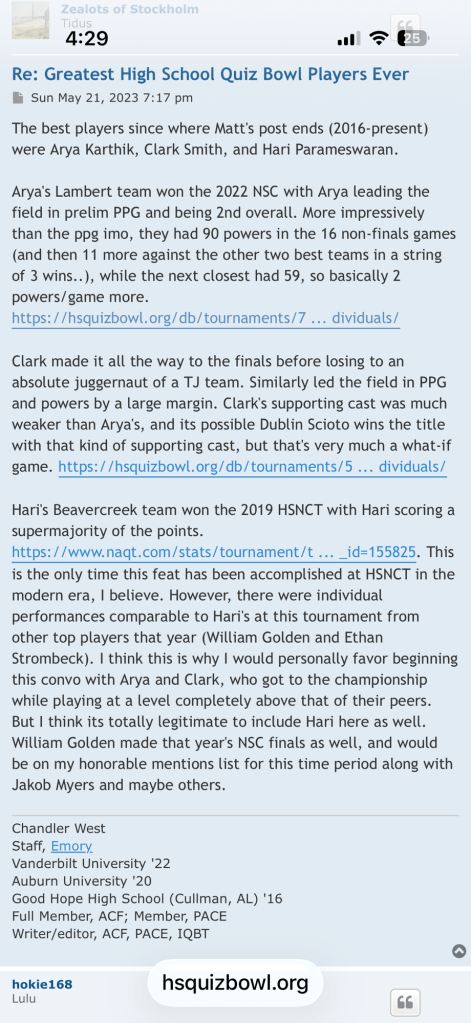
On “Before the Law”

The law is a cephalopodal organism whose concern is the doling out of legitimacy to those whom it has appropriated to itself. It consists of such institutions as: the law of embodiment (expressed so pithily by Althusser: “the trouble is, there are bodies and, worse still, sexual organs”‘); the law of reference (that every talking is a talking about something; that poetry, contra Mallarmé, is written with ideas and not with words); and the law of equivalence (specifically, the association of all that is human-shaped with the ideal-ego once misdiscovered in the mirror: with a self; and in this the establishment of a nobility-of-what-is that might tend to the law, administer it, as in “The Problem of Our Laws”). It may be observed that these are only the Real, Symbolic, and Imaginary under other names: the law is the complex which the three registers fill out, the tangle of tentacles as which one encounters them.

Insofar as the I does not really fit into this regime (for the I is not the self, the subject, the body, nor any weighted summation of the three, the law is a squeezing of the I out of the world. One of the clearer accounts of this squeezing-out is given in, of all places, the Epistle to the Romans: “Yet, if it had not been for the law, I would not have known sin. I would not have known what it is to covet if the law had not said, ‘You shall not covet.’ But sin, seizing an opportunity through the commandment, produced in me all …

“The Testimonial Problem of tExyn”

There is a motif common to several Balkan folktales, most prominently the Greek “The Bridge of Arta” and the Serbian “The Building of Skadar”: a prince or master builder is forced to immure his beloved young wife within the foundations of a large construction project to put an end to its repeated collapsing. Perhaps “The Building of Skadar” is most exemplary: in it, the motif is elaborated by the presence of three brother princes, each married, and a master builder who is told by a mountain-spirit that the fortress upon which he is laboring will not stand without the sacrifice of one prince’s wife. The three brothers agree to determine by chance which of their wives is to die, but the older two renege and warn their wives, leaving the youngest’s wife the only one with child to be sent to her death. Wher she realizes what is being done to her, she demands that a hole be made in the foundations so that she may continue to nurse her child.

Striving for the highest …

Poem from Elementary School

What we remember is the focus, energy, and drive to be the best in anything that Aadi Arya Karthik always displayed – tennis to math to music playing and composing to quiz bowl to philosophy – from a young age.

This poem for school perfectly captures that – the answer to “when can you call yourself a tennis player”

If

AADI KARTHIK

If you started before

The land of grade school accepted you,

And then put in

The passion,

And dedicated yourself

To it,

And made sure

You just

Enjoyed it,

————————-

If you

Hit,

Hit again,

Hit once more.

Forehands,

Backhands,

Serves,

Volleys,

Repeat,

———————————-

If five hours a week is

Commonplace

For you

Practicing,

Practicing,

Practicing,

The star player of your team

Practicing,

Practicing,

Practicing,

——————-

If when you get older

And older

You are playing better

And better

Going higher

In the society

Of tennis,

—————————

If finally

You reach it

Wimbledon

Australian Open

French Open

US Open

You have reached it.

The peak

The summit

Of all tennis

The grand slam

Tournaments

And once you

Reach them

You can call yourself

A true

Tennis Player.

It is a pre-teen’s take on Rudyard Kipling’s “If”

In memory of Aadi Arya Karthik

2004 – 2025

This site is a tribute to the life and legacy of Aadi Arya Karthik. Aadi Arya was a beloved child and friend, and this website is dedicated to preserving Aadi Arya’s memories.

Aadi Arya Karthik was a remarkable individual whose presence touched the lives of many. The brilliance, kindness, wisdom, and warmth will forever be cherished by those who had the privilege of knowing Aadi Arya. This website is a space to reflect on Aadi Arya’s life and share the positive impact on all of us.

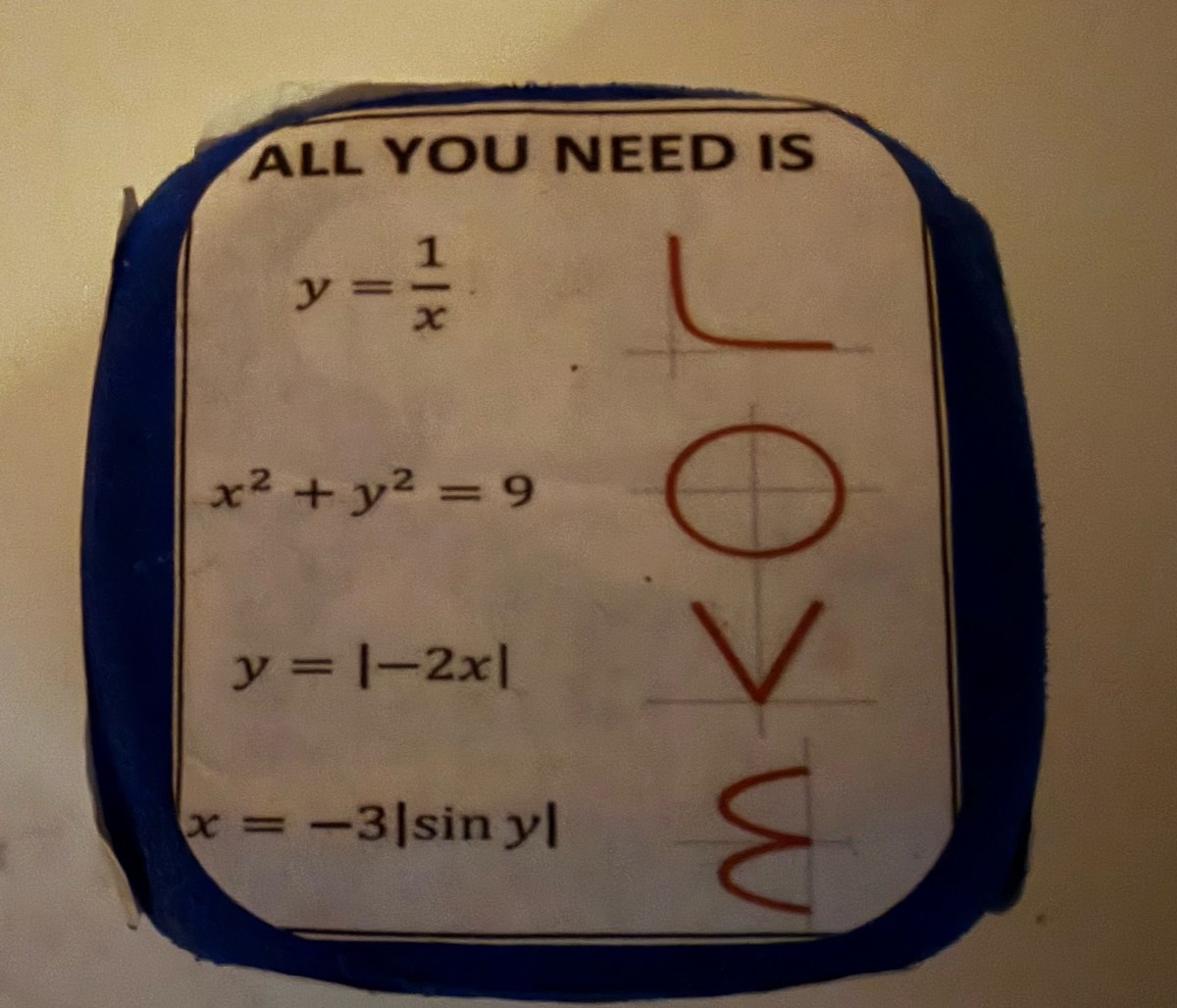
In life, Aadi Arya Karthik was modest, unassuming, and self-effacing – the last person you would expect to promote their achievements. For example, even when he was applying for college, he never put up a LinkedIn profile or any other social media page.

We thought long and hard about putting this website up to celebrate the life and achievements. Finally we decided that we don’t want Aadi Arya Karthik’s work to be forgotten and this is a small attempt to keep the memories alive among family, friends, and acquaintances.